

Key takeaways
- Five low floor balance beams for home karate training compared: folding 8 and 9-foot beams, a sectional beam, and a compact rehab beam for stance work.
Karate balance is built on a narrow base: a front stance holds one foot on a straight line while the other drives forward, and a roundhouse kick asks the supporting leg to stay planted while the kicking leg travels through the air. A low floor balance beam gives you a four-inch-wide line to walk, hold stances on, and drill slow kicks from, just two to four inches off the floor — so a wobble ends in a step down, not a fall.
A beam differs from a balance board or wobble disc. Boards roll and tilt under your feet, so the challenge is chasing a moving surface; a beam stays put, and the challenge is staying on the line. That line discipline transfers directly to stance work and single-leg kicking, and it builds ankle strength between dojo sessions.
All five beams below sit close to the floor, fold or break down for storage, and work barefoot, the way karate is trained. None replaces dojo practice — a beam is a conditioning tool, not a teacher of technique — but it gives you a narrow, honest surface to train on at home every day.
As an Amazon Associate, we earn from qualifying purchases.
How to Choose a Low Balance Beam for Karate Training
Length and room space. Full-size folding beams run eight or nine feet, giving you a real walking run of several steps without turning around. A nine-foot beam needs a clear stretch of floor, so measure your room first. If space is tight, a sectional beam starts at four feet and joins end to end. The shortest beam here, at about five feet, suits stationary drills rather than walking the line.
Height. Every beam here is two to four inches high. That low height is the point: you step off, you do not fall off. Two inches is the easiest starting point for beginners; four inches adds a little more consequence to a misstep. Raised beams with legs or adjustable heights are gymnastics apparatus, not home floor beams, and none appear here.
Top width. Four inches is competition width, and four of the five beams here use it: narrow enough to demand real balance, wide enough to stand on barefoot. The exception is the AIREX beam, six inches on one side and about nine and a half on the other — a wider, more forgiving surface aimed at balance and rehabilitation work. If you are coming back from an ankle sprain, the wider top is the honest choice.
Surface, cover, and core. Faux suede grips bare feet the way a competition beam does, which helps when you hold a stance or turn on the line. Vinyl and PVC covers are smoother and wipe clean with soap and water, which matters if the beam lives in a garage or a shared training room. Closed-cell foam, used by the AIREX beam, resists moisture. Most folding beams use EVA foam cores, firm enough to hold their shape underfoot and forgiving enough to cushion a misstep. A firm core matters: a beam that sags stops being a straight line.
Weight guidance, stated honestly. Only one listing here states a clear weight capacity: the ProsourceFit beam at 330 lb. Tumbl Trak’s maker states there is no weight limit on its sectional beam. The other listings publish no figure, and we do not invent one. Place the beam on a flat floor where it will not slide — most have an anti-slip bottom — and keep the area around it clear so a step-off lands on open floor.
1. MARFULA Folding Gymnastics Beam, 8 Ft, Blue
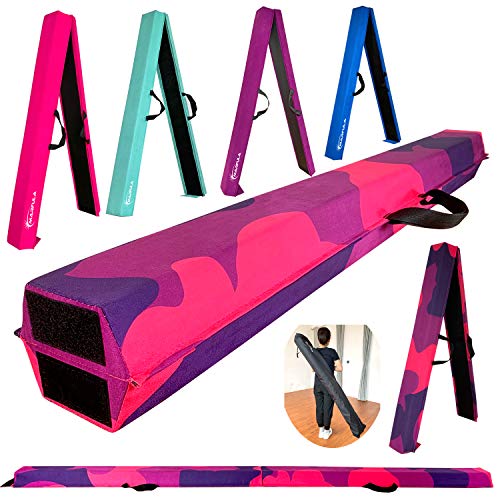
The MARFULA does everything a home beam needs to: a full eight-foot run, a competition-width top, a carry bag, and a hook-and-loop join that connects beams end to end for a longer line. The three-layer EVA core puts high-density foam outside and mid-density foam in the middle, so it feels firm underfoot without feeling hard. The faux suede cover grips bare feet, and the anti-slip bottom keeps it in place on a hard floor.
At two and two-tenths inches high when open, this is the lowest beam in the guide — a friendly first beam for younger students and stance drills. Folded, it halves to four feet and stands four and four-tenths inches high, so it stores in a closet. The hook-and-loop join does three jobs: the middle join keeps the open beam straight, the end joins lock it closed for storage, and the same ends link two beams into a sixteen-foot run.
Specs
- Length: 8 ft
- Height: 2.2 in open, 4.4 in folded
- Top width: 4 in, base width: 6 in
- Core: 3-layer EVA foam
- Cover: faux suede, anti-slip bottom
- Weight: 4.3 lb
- Carry bag included
2. We Sell Mats Folding Foam Balance Beam, 9 Ft, Purple

The We Sell Mats beam is the longest and lightest pick here: nine feet of walking line at just three pounds, so anyone in the household can carry and store it. The vinyl cover wipes clean and resists tears, and the beam folds to a compact fifty-five by six by eight inches.
The working surface is four inches wide with a six-inch base, the same competition-width geometry as the MARFULA, and the height runs about two to two and a half inches — low enough that a step-off is nothing. The brand is a member of the USA Gymnastics Supplier Network, a useful signal in a category full of lookalike listings. Care is simple: hand wash only, which means wiping the vinyl down after a sweaty session.
Specs
- Length: 9 ft
- Height: about 2 to 2.5 in
- Top width: 4 in, base width: 6 in
- Cover: vinyl, hand wash only
- Weight: 3 lb
- Folded size: 55 x 6 x 8 in
3. AIREX Balance Beam, Blue
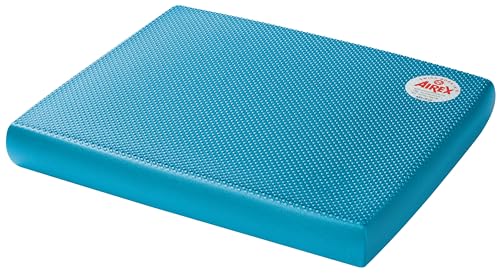
The AIREX beam is the outlier here. At just under sixty-three inches — about five feet three inches — it is shorter than a typical folding beam, and its top is far wider: six inches on one side, about nine and a half on the other. Flip it over and the difficulty changes. It is a balance-training tool rather than a walking beam — you stand on it, shift your weight, hold stances, and work single-leg balance in place.
The beam is a single piece of closed-cell AIREX foam, the same material used in the brand’s balance pads, and it weighs about five pounds. It is the rehab pick of the lineup, suited to karate students rebuilding ankle stability after a sprain or adding slow balance work to recovery days. No weight limit is stated on the listing, so we state none here. One hard rule: bare feet only, since shoes damage the foam surface.
Specs
- Length: 62.99 in (about 5.3 ft)
- Width: 9.45 in, height: 2.36 in
- Top width: 6 in one side, 8.25 in the other (reversible)
- Material: closed-cell foam
- Weight: 5 lb
- Model: AR-BEAM, part 30-1913
- Bare feet only
4. Tumbl Trak Sectional Floor Balance Beam

The Tumbl Trak beam takes a different approach: instead of folding, it comes in four-foot sections that join end to end with hook-and-loop ends. One section is a compact balance station for a small room; two make an eight-foot run; three make twelve feet. You buy the length you have room for and extend it when your space or ambition grows. A two-pack is available from the maker for the eight-foot run from day one.
Each section is four inches high with a four-inch top that tapers to an eight-inch base — the widest base in the guide, which makes the sectional beam stable. The core is two-layer foam under a synthetic suede cover, and each section weighs two pounds, so a child can carry one alone. The maker states there is no weight limit on these beams. Colors are supplied at random.
Specs
- Length: 4 ft per section (join 2 or more for an 8 ft run)
- Height: 4 in
- Top width: 4 in, tapering to an 8 in base
- Core: two-layer foam
- Cover: synthetic suede
- Weight: 2 lb per section
- Join: hook-and-loop ends; colors random; 2-pack available
5. ProsourceFit Folding Balance Beam, 9 Ft
The ProsourceFit beam is the only pick here that states a clear weight capacity — 330 lb — the straightforward choice for adults and shared households. It is a pure floor beam: nine feet long, four inches on top, six inches at the base, with no legs and no height adjustment. There is nothing to set up; unfold it, lay it down, and train.
The EVA foam core is firm and forgiving, and the PVC cover is water-resistant and wipes clean with soap and water. The beam folds in half for storage, and at nine feet it ties with the We Sell Mats beam for the longest walking run here. If you want one beam, one length, and a published capacity figure you can rely on, this is the pick.
Specs
- Length: 9 ft
- Top width: 4 in, base width: 6 in
- Core: EVA foam
- Cover: PVC, water-resistant, wipe-clean with soap and water
- Folds in half for storage
- Weight capacity: 330 lb
- Floor-only design, no legs or height adjustment
How the Five Beams Compare
Length splits the group. The We Sell Mats and ProsourceFit beams give you the longest single-piece runs at nine feet; the MARFULA gives you eight feet, joinable to sixteen; the Tumbl Trak gives you four feet per section, extendable to whatever your room allows; the AIREX, at about five feet three inches, is a stationary balance tool rather than a walking beam.
Height is close across the group — two to four inches — with the Tumbl Trak tallest at four inches and the MARFULA lowest at two and two-tenths. Top width is four inches everywhere except the AIREX, whose reversible sides make it the easiest beam to stand on. Weight runs from two pounds per Tumbl Trak section to five pounds for the solid AIREX beam. For karate training, walking drills favor the nine-foot beams, small rooms favor the sectional Tumbl Trak, and ankle rehab favors the AIREX.
FAQ
Can I use a balance beam barefoot for karate training?
Yes. All five beams here are designed for barefoot use, and the AIREX beam must be used barefoot — shoes damage its foam surface. Faux suede and vinyl covers both grip bare feet well. Keep your feet clean and dry, and wipe the beam down after a session.
How long a beam do I need at home?
Eight or nine feet gives you a full walking run for stance sequences and footwork drills. A four-foot sectional beam works in a small room and joins to eight feet with a second section. The five-foot-three-inch AIREX beam is best for stationary drills — stance holds, slow weight shifts, and single-leg stands — rather than walking the line. Measure your floor space first.
Is a balance beam the same as a balance board?
No. A balance board or wobble disc tilts and rolls under your feet, so the training is reactive — your ankles and core constantly correct a moving surface. A beam is fixed: the training is line discipline, keeping your hips level and your weight centered on a narrow path that does not move. A beam is the better tool for stance work and kick balance because it holds still while you move.
Are low floor beams safe for kids?
A floor beam two to four inches high is about as safe as balance equipment gets: a wobble ends in a step down, not a fall from height. Younger children should still be supervised, the beam should sit on a flat, non-slip floor with clear space around it, and it should be stored away when not in use. Start younger students on the lowest, widest option before moving to a four-inch top.
Conclusion
A low floor balance beam is a simple, honest training tool: a narrow line, a few inches off the floor, that rewards straight steps and steady hips. The nine-foot We Sell Mats and ProsourceFit beams give you the longest runs, with the ProsourceFit adding a published 330 lb capacity. The MARFULA is the most versatile pick, with a carry bag and the only end-to-end join here. The Tumbl Trak fits small rooms and grows with your space, and the AIREX suits slow, deliberate rehab rather than walking drills.
Whichever beam you choose, use it the way karate is trained: barefoot, patiently, and a little every day. A few minutes a day will do more for your balance than an occasional long session. The beam does not teach technique, but it gives you a place to practice the balance every technique stands on.
More from Amazon
Programs that pair well with the guide above. Offers and eligibility are set by Amazon and may change.
Free shipping on eligible items, Prime Video and more. Eligible new members can start with a free trial.
Start a Prime free trialA Prime membership for ages 18-24 with a trial period. Eligibility is set by Amazon.
See Prime for Young AdultsAudiobooks and podcasts to listen to on the go. Eligible new members can start with a free trial.
Try Audible freeAd-free music streaming. Eligible new subscribers can start with a free trial.
Try Music Unlimited freeAs an Amazon Associate we earn from qualifying purchases.
Write Your Review
No reviews yet. Be the first to share your experience!