

Key takeaways
- A good home karate training space needs three things: enough clear floor for your longest technique, a surface that grips without grabbing your feet.
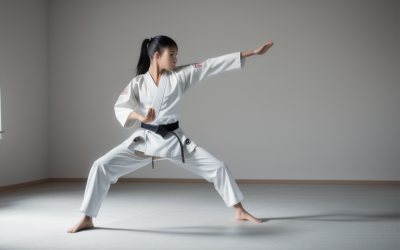
A good home karate training space needs three things: enough clear floor for your longest technique, a surface that grips without grabbing your feet, and a wall or mirror that lets you check your form. Most students can meet all three in a spare room, a garage corner, or a cleared section of a living room.
This guide walks through measuring the room, choosing flooring, handling safety, and setting up simple training stations. It is written for adults, teens, and parents setting up a space for a child who trains between classes. Nothing here requires construction or a large budget, and each step can be adjusted for apartments and shared homes.
Start by Measuring What You Actually Need
Stand in your chosen spot with arms extended to the sides and turn slowly. If your fingertips touch nothing, you have the minimum clearance for basic techniques. Then take a long step forward in a front stance and swing a high kick; nothing should be within reach of your foot.
Kata is the next measuring tool. Many forms travel several steps forward, backward, and diagonally. Walk through your longest kata at slow speed with the lights on. Mark the footprint with tape, then add a comfortable buffer on all sides. If the pattern does not fit, you can still practice the form in sections or turn it to use the room diagonally.
Ceiling height matters for taller students and anyone practicing jumping or high kicks. Look up for ceiling fans, hanging lights, and low beams before your first session.
Choose the Right Floor Surface
Hard Floors
Wood, laminate, and tile are common in homes. They are stable, but they can be slippery in socks and unforgiving for falls or repeated stance transitions. If you use a hard floor, check for loose boards and wipe the surface before every session so dust does not reduce grip.
Carpet
Carpet feels forgiving, but thick or loose carpet can twist ankles and knees during pivots. Short, firmly attached carpet is easier to train on than plush pile. If you pivot a lot in kata, watch how your feet catch on the fibers.
Interlocking Mats and Rolled Mats
Foam interlocking tiles and rolled martial arts mats give cushioning and a defined training area. Look for a surface that is firm enough to keep your stances stable, since very soft foam can feel unsteady under a horse stance. Interlocking tiles should have edge pieces so the border does not catch toes.
Floor Surface Comparison
| Surface | Grip | Joint Comfort | Best Use | Watch Out For |
|---|---|---|---|---|
| Wood or laminate | Fair, slippery in socks | Low cushioning | Kata and stance drills | Slips and hard landings |
| Tile or concrete | Varies | Poor cushioning | Light basics only | Cold, hard, unforgiving |
| Short carpet | Good | Moderate | General practice | Foot catching during pivots |
| Interlocking foam | Good | High cushioning | Conditioning, children | Soft feel under deep stances |
| Rolled martial arts mat | Good | Moderate to high | Full training sessions | Storage space, curling edges |
Safety First: Walls, Furniture, and Lighting
Safety planning is the part most people skip. Move coffee tables, floor lamps, and anything with sharp corners out of the zone. Check windows and glass doors in your kicking line, since a missed chamber can reach farther than expected.
Keep a Buffer Around Walls
Leave at least an arm and leg length between your training area and the nearest wall for kicks. If the room is small, practice kicks along the longest wall at an angle so a mistimed technique has room to fall short.
Good Lighting and Ventilation
Bright, even light helps you see your form in a mirror and spot hazards on the floor. Ventilate the room or open a window, especially for longer sessions, and keep water within reach.
Plan for Children and Pets
If children or pets share the home, set a rule that nobody enters the space while you are training. A rolled mat that is put away after each session can help signal when the area is active.
Add Simple Training Stations
You do not need a full dojo. A few small additions turn a cleared room into a useful training area without crowding it.
- A mirror or a spot where you can prop up a phone to record yourself from the side and front.
- A wall space for stretching, flexibility work, and checking posture.
- A storage bin or shelf for belts, pads, and a water bottle so equipment does not clutter the floor.
- A small clock or timer so rounds and rest periods stay consistent.
- A marked line or tape guide to practice stance width and kata direction.
Before You Start Checklist
- Measure arm span and kick range, then clear that area plus a safety buffer.
- Remove or pad sharp furniture corners and secure loose rugs.
- Check ceiling height and overhead lights before high kicks.
- Choose a floor surface that grips without catching your feet.
- Check your lighting and mirror position before the first session.
- Agree on house rules with family members about when the area is in use.
Noise, Neighbors, and Shared Living
Apartment training raises a question that dojo training does not: how much noise will carry? Stomping stances, loud kiai, and landings from jumps travel through floors. If you share walls or have neighbors below, favor slow, controlled kata and stance work, and save louder power drills for class. A thick mat or rug under the training zone absorbs part of the impact and also protects the floor finish.
Let housemates know your schedule. A fixed block, for example early evening on three weekdays, avoids surprises and prevents family members from walking into the middle of a kick. If the space doubles as a bedroom or home office, store gear in a closed bin so the room returns to normal quickly.
Children in the household often want to join in. Set a separate, safe spot and a simple rule that the training zone is for adults or the student only. That keeps younger siblings from running into a swinging leg and keeps the session calm.
Finally, think about cleaning. Sweat and dust build up on mats and mirrors quickly. A quick wipe-down after each session with a damp cloth keeps the surface grippy and the room fresh, and it makes the next day’s setup quicker.
Make the Space Easy to Use Every Day
The best training space is one you will actually use. If setting up takes fifteen minutes, you will skip sessions. Keep your mat rolled in a corner, store your uniform nearby, and leave the clock where you can see it. A small ritual, such as bowing when you enter the space, helps shift your mind from home mode to training mode.
If you share the room with other activities, consider a fold-away approach. Roll the mat against the wall after practice, return furniture to its place, and keep tape guides removable so the room still works for the rest of the household.
Finally, revisit the setup every few months. As your kata grows longer or your kicks get higher, your space needs may change. A quick re-measure and a short safety walk-through keep the area working for you.
Related guides
- How To Size Karate Sparring Gloves And Shin Guards
- How To Practice Karate At Home Without A Partner
- Puzzle Foam Mats For Home Karate Practice
Frequently Asked Questions
How much space do I need for karate at home?
A clear area that fits your arm span with room to step forward is enough for basics. Longer kata and high kicks need more length and ceiling clearance, so measure your longest form before deciding.
Do I need mats to train karate at home?
Mats are not required, but they can improve comfort and safety on hard floors. If you train barefoot on a stable, non-slip surface, many students manage fine without them for basics and kata.
Is it safe to practice kicks in a small apartment?
It can be, with some adjustments. Practice slow, controlled kicks, keep fragile objects out of range, and avoid training near glass or stairs. If your downstairs neighbors may be affected, avoid heavy stomping and jumping.
Should I put a mirror in my training area?
A mirror is one of the most useful additions because it lets you correct stance, posture, and guard on the spot. If a wall mirror is not possible, prop up a phone and record short clips to review your form in 2026 and beyond.
More from Amazon
Programs that pair well with the guide above. Offers and eligibility are set by Amazon and may change.
Free shipping on eligible items, Prime Video and more. Eligible new members can start with a free trial.
Start a Prime free trialA Prime membership for ages 18-24 with a trial period. Eligibility is set by Amazon.
See Prime for Young AdultsAudiobooks and podcasts to listen to on the go. Eligible new members can start with a free trial.
Try Audible freeAd-free music streaming. Eligible new subscribers can start with a free trial.
Try Music Unlimited freeAs an Amazon Associate we earn from qualifying purchases.



Write Your Review
No reviews yet. Be the first to share your experience!