

Key takeaways
- Pros: seamless surface, fast setup, tatami or smooth options, made in the USA with a one-year limited warranty
- Cons: premium cost, firm feel for hard falls beyond basic breakfall practice, edges need tape when joining mats
The best martial arts mat for most home dojos is a roll-out or tatami-top interlocking system about 1.25 to 1.5 inches thick, and for a karate-focused space the Dollamur Flexi-Roll 5×10 and the Greatmats Home BJJ/MMA 1.5-inch tiles are the two strongest all-round answers. Roll-outs give a seamless surface that is fast to set up, while 2×2 foot interlocking tiles let you build almost any footprint and replace one damaged piece at a time. If you only practice kata, stretching and light pad work, a 3/4-inch foam tile or a folding panel mat is enough and costs far less.
This guide is built around the way karateka actually train at home: bare feet, sliding stances, turning on the ball of the foot, falls and sweeps for those who cross-train, and the need to put the floor away so the room can be used for something else. Every pick below is a real, currently sold product, and the specifications come from the manufacturers’ own listings and spec sheets. Pay attention to the comparison table and the sizing section, because choosing the wrong thickness or footprint is the most common reason people replace a mat within a year.
Our top picks


As an Amazon Associate we earn from qualifying purchases at no extra cost to you.
Quick Comparison of the 7 Best Martial Arts Mats
| Pick | Best for | Format and size | Thickness | Weight | Cost tier |
|---|---|---|---|---|---|
| Dollamur Flexi-Roll 5×10 (vinyl or tatami top) | Best overall for kata and kumite | Roll-out, 5 ft x 10 ft (50 sq ft) | 1.25 in | 20 lb per mat | Premium |
| Dollamur Flexi-Connect 10×10 | Best for a full-size sparring area | Two 5×10 sections joined with hook-and-loop, 100 sq ft | 1.25 in | 20 lb per section, about 40 lb total | Premium |
| Greatmats Home BJJ/MMA Puzzle Mat | Best interlocking tile for throws and grappling | 2 ft x 2 ft EVA tiles, 10-pack covers 38.75 sq ft | 1.5 in | Light enough to carry two or three at once | Mid |
| Meister X-Thick Interlocking EVA Mats | Best for extra cushioning on a budget | 2 ft x 2 ft tiles, 10-pack covers 40 sq ft | 1.5 in | Light closed-cell EVA | Mid |
| Gold BJJ Extra Thick Puzzle Mats | Best small-footprint starter set | 12 tiles at 20 in x 20 in, about 33 sq ft | 1.5 in | Roughly 2 lb per tile | Mid |
| Greatmats Home Sport and Play Mat | Best for stand-up karate and shoe-friendly drills | 2 ft x 2 ft reversible tiles, 10-pack covers 38.75 sq ft | 3/4 in (20 mm) | About 2 lb per tile | Budget |
| BalanceFrom 4×10 Folding Panel Mat | Best for apartments and quick storage | 4-panel fold, 4 ft x 10 ft | 2 in | About 15 lb | Budget |
Best Overall: Dollamur Flexi-Roll 5×10
The Flexi-Roll is the mat many dojos use in their own training halls, scaled down to a home size. Per Dollamur’s spec sheet, the 5 ft by 10 ft vinyl-covered version is 1.25 inches thick, made from closed-cell cross-linked polyethylene foam with a 24 oz vinyl cover that is designed not to crack or peel. Each mat weighs about 20 pounds and rolls to under 17 inches in diameter, so it can lean in a closet corner when you are done. Dollamur offers smooth, hybrid tatami and no-mark versions, and the tatami-textured surface is the better choice if you want a more traditional feel underfoot.
For karate the main advantage is the surface. A continuous roll has no puzzle seams to catch a toe during a sliding step or a turning kick, and the firm foam gives a stable platform for stances. A single 5×10 mat gives you enough length for a heian or taikyoku kata line, and two mats taped or joined side by side make a proper square. The foam is firm rather than plush, which is what you want for balance work; very soft floors make ankles work harder and blur your feel for the ground.
Trade-off: It is the most expensive way to cover a small area, and the length can vary by about half an inch from mat to mat, so you will see a thin gap when you place two side by side unless you use tape or the connected version. It is also a floor-lying mat, not a wall-to-wall system, so it will slide on polished hardwood unless the room has a bit of grip underneath.
Who it suits: Adults and teens who train three or more times a week, instructors running a small home class, and anyone who values a seamless surface above all else.
- Pros: seamless surface, fast setup, tatami or smooth options, made in the USA with a one-year limited warranty
- Cons: premium cost, firm feel for hard falls beyond basic breakfall practice, edges need tape when joining mats
Best for a Full Sparring Area: Dollamur Flexi-Connect 10×10
If you want a regulation-style practice square without taping seams, the Flexi-Connect solves the joining problem. It uses the same 1.25-inch closed-cell foam and vinyl surface as the Flexi-Roll, but arrives as two 5 ft by 10 ft sections that already carry a hook-and-loop connection, creating a 10 ft by 10 ft mat. Dollamur lists about 20 pounds per section, so roughly 40 pounds in total, and each rolled section stays under 17 inches across. Straps are included so the rolls stay tidy in storage.
A 10 by 10 foot area is a practical minimum for light kumite drills, partner ippon kumite, and ground-contact work like basic judo-style throws. It also fits two people practicing kata in parallel. Because the join is built in, you avoid the peeling tape line that appears on cheap roll-out setups after a few months of foot traffic.
Trade-off: This is a bigger investment and the largest footprint on the list, so make sure your room can take a 100 square foot rectangle before ordering. The firm foam is made for training rather than serious high-amplitude throwing, so heavier judo or wrestling use calls for a thicker system.
Who it suits: Home dojos, families who train together, and instructors who want a square that matches what students will meet at tournaments.
- Pros: built-in joining, 100 sq ft in one purchase, same durable vinyl or tatami options, strap-ready storage
- Cons: heaviest total weight, requires a dedicated room, premium cost
Best Interlocking Tile for Throws and Grappling: Greatmats Home BJJ/MMA Puzzle Mat
Greatmats lists its Home BJJ/MMA tiles as 2 ft by 2 ft and 1.5 inches thick, made from EVA foam with a tatami-textured, no-skin-burn surface. They are double-sided in red and blue, interlock without adhesive, and include two border strips per mat for a finished edge. A 10-pack covers 38.75 square feet once the interlocking loss is counted, and Greatmats states a 4-foot ASTM fall rating for its 1.5-inch tatami puzzle mat in the 2×2 ft size, which is a useful number if you practice throws in a garage.
For karate students who also study judo, jujutsu or ground defense, this is the thickness that makes falls forgiving without turning stances unstable. The tatami texture also has a plausible look and feel for a traditional dojo, and the tiles lift out individually if a corner is damaged. Because you can add tiles one box at a time, you can start with a kata and drill area and grow later.
Trade-off: Foam tiles can shift under aggressive movement, particularly if the floor is smooth. Check that edges are firmly seated before each session, and place the mat against a wall or a rubber underlay where possible. The seams are small but real, so people with very precise sliding footwork should run a hand across them before training.
Who it suits: Cross-trainers, parents setting up a garage dojo for several kids, and anyone who wants a scalable system from a major martial arts flooring supplier.
- Pros: 1.5-inch cushion, tatami surface, expandable, replaceable tiles, border strips included
- Cons: seams, tiles can separate under hard pivots, needs a flat floor
Best Budget Cushion: Meister X-Thick Interlocking EVA Mats
Meister’s X-Thick line is sold as 10 tiles per pack, each 24 inches square, for 40 square feet of nominal coverage. The tiles are 1.5 inches thick closed-cell EVA, which Meister describes as 50 percent thicker than standard flooring mats. They are reversible with anti-slip T-pattern surfaces on both sides and ship with border pieces; larger packs of 16 and 36 tiles are also offered, along with several color choices.
The appeal here is simple: you get the same cushion depth as dedicated grappling tiles in a general fitness-style product. That suits tumbling, breakfall practice for children, and take-down drills with a partner. The anti-slip surface works with bare feet and with soft training shoes, which is handy if you practice weapons forms with sandals or want to keep the mat clean with shoes in the room.
Trade-off: It is marketed toward wrestling, MMA takedowns and gymnastics rather than a tatami-style dojo, so the surface is more grippy than glide-friendly. Footwork with deep sliding steps, like sanchin or zenkutsu dachi transitions, may feel a little sticky. The listing does not publish foam density, so expect a softer feel than a dense dojo tile.
Who it suits: Families, beginners on a tight allowance, and anyone building a mixed-use play and training room.
- Pros: deep 1.5-inch cushion, reversible, many color options, scalable pack sizes
- Cons: grippier surface, density not published, softer foundation for stance work
Best Small-Footprint Starter: Gold BJJ Extra Thick Puzzle Mats
Gold BJJ sells a 12-tile set where each tile measures 20 inches by 20 inches and 1.5 inches thick, adding up to about 33 square feet. The surface has a tatami texture, and each tile is black on one side and grey on the other. That footprint works out to roughly 5.5 by 6 feet, a good size for one person drilling kata, partner pad work, or a short line of kihon.
The key detail is that colors on opposite faces should not be mixed next to one another within one continuous mat, so lay the set with one face up throughout. If you need a bigger space, two packs reach about 66 square feet, which is close to 8 by 8 feet and a realistic minimum for light sparring.
Trade-off: The non-standard 20-inch tile size means you cannot mix them with standard 2-foot tiles. Individual tiles can separate under aggressive movement, so keep the area free of heavy pivoting if you practice karate with fast turning techniques.
Who it suits: Solo trainers, apartment dwellers with a spare corner, and anyone wanting to try a thick tile before committing to a full room.
- Pros: 1.5-inch depth, tatami texture, small starting footprint, easy to carry
- Cons: non-standard tile size, tiles can shift, one-side-at-a-time color rule
Best for Stand-Up Karate and Shoes: Greatmats Home Sport and Play Mat
Stand-up training does not need a deep landing zone, and this 3/4-inch tile reflects that. Greatmats lists each 2 ft by 2 ft EVA foam tile as 20 mm thick, with a Shore C hardness of 35, a thatch-style reversible finish, and roughly 2 pounds of weight. A 10-pack covers 38.75 square feet and includes two border strips per tile. Greatmats says the surface is meant to tolerate wrestling shoes, tennis shoes, boxing shoes and bare feet, so it also handles those evenings when someone trains in indoor shoes.
For kata, kihon and bag work the lower profile is an advantage. A thinner mat keeps your ankles closer to a hard floor feel, which is closer to a tournament surface, and it is far less likely to compress under your supporting foot during a roundhouse kick. It is also much lighter to store and move.
Trade-off: It is not a throwing or breakfall surface. The listing is indoor only and not UV treated, so it should not live on a sunny porch, and thatch texture has a little more grip than a smooth tatami top.
Who it suits: Karate students who mostly practice kata and kihon, parents of younger students, and shared rooms where the floor needs to be cleared fast.
- Pros: low-profile feel, shoe-friendly, reversible, light, budget-friendly coverage
- Cons: too thin for falls, indoor only, grippier than tatami
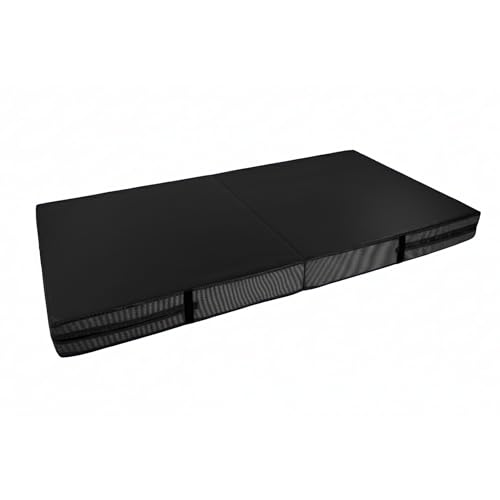
Best for Apartments and Quick Storage: BalanceFrom 4×10 Folding Panel Mat
If you have no dedicated room, a folding mat solves most of the problem. The BalanceFrom 4-panel model measures 10 ft by 4 ft unfolded and is 2 inches thick, covering 40 square feet. It folds down to about 4 ft by 4 ft and 8 inches deep with built-in carry handles, and retailer listings put it at around 15 pounds. The cover is double-sided, non-slip, moisture-resistant vinyl, and hook-and-loop strips on all four sides let you connect more than one mat.
This is the format that wins when the floor has to return to being a living room in five minutes. The extra thickness gives more padding than a 3/4-inch tile for partner drills and basic rolls, yet the hinge lines are visible and can be felt through bare feet.
Trade-off: Folding panels are built for gymnastics and general fitness, so the fold seams are a weak spot for repeated sliding steps and the vinyl surface can be slick when sweaty. It is not the right choice for hard throws.
Who it suits: Renters, students sharing a space, and beginners testing out home practice.
- Pros: folds flat, handles, connectable, firm 2-inch padding, lightweight
- Cons: fold lines, slick when wet, built for fitness rather than martial arts
How to Choose a Martial Arts Mat
Thickness: match it to what hits the floor
Thickness is the main decision, and it depends on how often you leave your feet. Sources that cover mat safety commonly place 3/4 inch as a floor-protection layer, 1.25 inches as a general dojo practice depth, and 1.5 inches or more as the territory for repeated throws, judo-style falls and grappling. For a karate student who does not practice throws, anything beyond 1.5 inches just makes stances harder to hold. A softer, thicker mat also makes the ankle and arch work harder on every step, which can tire beginners.
Surface: smooth, tatami or thatch
Smooth vinyl is easy to wipe and glides well, but it can become slick with sweat. Tatami-textured surfaces mimic traditional rice-straw mats, add a little traction and reduce skin friction burns. Thatch and T-pattern finishes add the most grip, which feels secure for squatting and holding stances but can slow quick pivots.
Format: roll-out, tiles or folding panels
| Format | Setup time | Seams | Expandable | Best use |
|---|---|---|---|---|
| Roll-out | About 1 minute | None, or one hook-and-loop line | Limited | Dedicated home dojo, regular classes |
| Interlocking tile | 5 to 15 minutes depending on size | Many small seams | Excellent | Garages, growing setups, throws practice |
| Folding panel | Under 1 minute | 2 to 3 fold lines | Moderate | Apartments, short sessions |
Worked Example: How Much Mat Do You Need?
Start with the activity, not the room. A single kata line for most adult students needs about 8 to 10 feet in the direction of travel and 3 to 4 feet in width, which is why a single 5×10 roll is such a good fit. Partner kumite practice and sweeps need at least 8 ft by 8 ft, and a comfortable square for two pairs working in parallel is 10 ft by 10 ft.
- Measure the clear floor. Remove furniture and note the longest straight line. If it is under 8 feet, use the folding panel or a pair of 4×10 mats side by side.
- Convert to tiles. A square that is 8 ft by 8 ft with 2 ft tiles needs 16 tiles, and a 10 ft by 10 ft square needs 25 tiles. Buy a 10-pack plus a second and a third pack, then add border pieces.
- Handle non-standard tiles. With 20-inch tiles, a 5 by 5 layout gives 100 inches square, about 8.3 feet on a side and 25 tiles. A 6 by 6 layout reaches 10 feet and needs 36 tiles.
- Subtract the interlock loss. Interlocking tiles lose a small amount of coverage to the puzzle edges, which is why a nominal 40 square foot pack may be listed as 38.75 square feet for finished coverage.
- Check weight and storage. A 5×10 roll at 20 pounds averages 0.4 pounds per square foot, a 2 ft tile at about 2 pounds is around 0.5 pounds per square foot, and the folding panel at about 15 pounds over 40 square feet is just under 0.4. Heavier mats are better in the garage, lighter ones are easier to carry up stairs.
Decision Matrix by Situation
| Your situation | Best pick | Why |
|---|---|---|
| Train 3+ times a week at home, kata and kumite | Dollamur Flexi-Roll 5×10 | Seamless, durable, quick to set up |
| Run small group classes | Dollamur Flexi-Connect 10×10 | Full 100 sq ft square |
| Mix karate with judo or jujutsu | Greatmats Home BJJ/MMA | 1.5-inch cushion with a tatami surface |
| Kids who tumble and play | Meister X-Thick | Deep cushion at moderate cost |
| Solo trainer with a small room | Gold BJJ 12-tile set | Compact 33 sq ft footprint |
| Mainly kata and kihon | Greatmats Sport and Play | Low profile, shoe tolerant |
| Shared apartment | BalanceFrom folding mat | Folds flat in under a minute |
Durability and Ownership Realities
Most mats fail in predictable places. Interlocking tiles lose their corners first, usually where people pivot, and the tabs can crack if tiles are pulled apart by one corner. Pull them straight apart and keep a spare tile or two. Roll-outs tend to wear along the edges, especially if rolled tightly with debris trapped inside. Vinyl covers can scuff but should clean easily with a damp cloth.
- Cleaning: Wipe after each session with a mild cleaner designed for vinyl or foam. Avoid harsh solvents, which can dry out or discolor EVA and PE foam.
- Foot hygiene: Bare feet should be clean and dry. A mat that is cleaned weekly and aired out resists odor and skin irritation.
- Flooring below: Use the mat on a flat, dry floor. A tiny dip or a moist concrete slab will create curled edges and mildew.
- Sunlight and heat: Many foam tiles are indoor only and not UV treated, so a sunny window or a hot garage can warp them.
- Common mistake: Buying a thicker mat than your training needs. A stance-heavy karate routine does not benefit from a 2-inch soft floor.
Remember that mats reduce impact but do not remove injury risk. If you plan on throws or falls, learn them from a qualified instructor and consider a professional opinion if you have joint or back concerns.
Frequently Asked Questions
How thick should a home karate mat be?
For kata, kihon and light kumite, 3/4 inch to 1.25 inches is enough and gives better balance. Choose 1.5 inches if you also practice throws or breakfalls. Anything softer and thicker can make stance work feel unstable.
Is a roll-out mat better than interlocking tiles?
A roll-out is better for a seamless surface and fast setup, which suits regular karate practice. Tiles win on flexibility and replaceability. If the mat stays down all week and you want a clean floor, roll-outs are more comfortable, but tiles are easier to expand later.
Can I use these mats on concrete or hardwood?
Yes, on a flat, dry floor. Concrete should be dry before use, and polished hardwood can make lightweight mats slide, so place a non-slip underlay or tape the edges. Always check the manufacturer’s care instructions, because some foam tiles are indoor only.
How big should a kumite practice area be?
Plan for at least 8 ft by 8 ft for light partner drills and 10 ft by 10 ft for comfortable movement. Official tournament areas are larger, but a 100 square foot home mat is enough for most technique work.
Do I need a tatami-textured surface?
Not strictly. Tatami texture adds a traditional feel and reduces friction burns on bare skin, while smooth vinyl is easier to clean. Pick based on how often you slide, turn and fall in a session.
How do I clean and store a martial arts mat?
Wipe it down with a damp cloth and mild cleaner after use, let it dry fully, and store it flat or loosely rolled. Do not fold roll-out mats, and keep tiles out of direct sunlight.


Write Your Review
No reviews yet. Be the first to share your experience!