

Our Short List of 3

- Best for: All-day sitters who want the reference mesh chair and a long warranty.
- 8Z Pellicle suspension mesh seat and backrest, eight tension zones, no foam
- PostureFit SL dual-pad lumbar support, height and depth adjustable
- Three sizes (A, B, C); Size A weight capacity 300 lb
- Fully adjustable arms: height, depth, width, and pivot
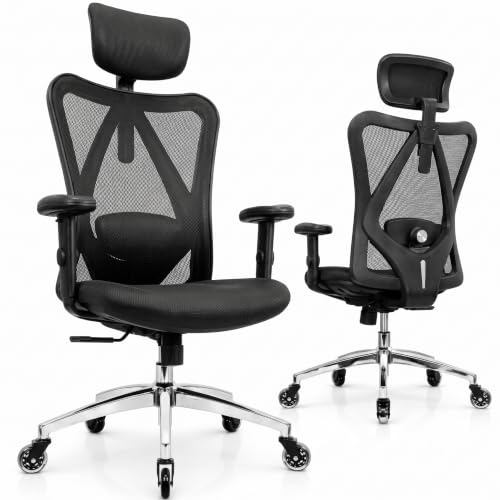
- Best for: Heavier sitters who want the strongest lumbar adjustment in this guide.
- 4D lumbar support, adjustable up, down, in, and out
- Breathable mesh back with thick memory foam seat cushion
- Multiple recline angles with adjustable tilt tension
- Height-adjustable armrests
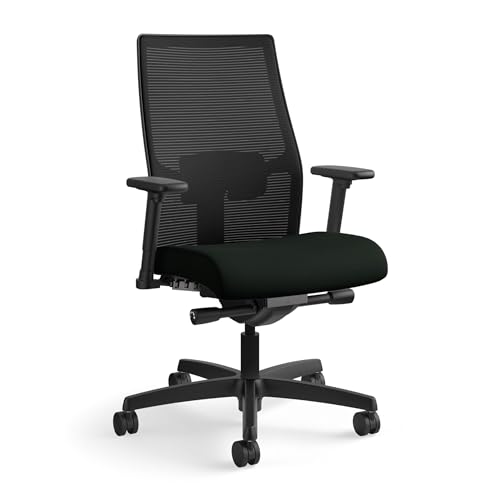
- Best for: Desk workers who want synchro-tilt, seat-slide, and a lifetime warranty.
- Spectrum mesh mid-back
- Advanced Synchro-Tilt mechanism with tension control
- Adjustable lumbar support
- Height- and width-adjustable arms
All 5 Picks at a Glance
| Product | Specs | Action |
|---|---|---|
| Herman Miller Aeron Remastered |
| Check price on Amazon |
| Duramont Ergonomic Office Chair |
| Check price on Amazon |
| HON Ignition 2.0 Mid Back Task Chair |
| Check price on Amazon |
 GABRYLLY Ergonomic Office Chair |
| Check price on Amazon |
 NOUHAUS Ergo3D Ergonomic Office Chair |
| Check price on Amazon |
Key takeaways
- Compare five ergonomic mesh office chairs by support, airflow and adjustability, so long workdays stay comfortable without back strain or sweat.
A chair that feels fine for the first hour can turn into a problem by the sixth. The seat begins to press into the backs of your thighs, the mesh sags where your shoulders rest, and the lumbar pad that looked adjustable on the listing sits a few centimetres away from the curve of your spine. When you sit for a full workday, the decision is not about which chair looks best in a photo. It is about which one keeps your back supported, your body cool, and your posture steady from the first call to the last email.
This guide is for remote workers who sit for eight hours or more, home-office builders replacing a basic task chair, taller or broader sitters who struggle with standard sizes, and anyone whose current chair leaves them warm, stiff, or shifting by mid-afternoon. The five chairs below were chosen from their Amazon listings by name and listed specifications, with mesh construction, adjustable lumbar support, and all-day adjustability as the deciding factors.
Quick Picks
As an Amazon Associate we earn from qualifying purchases.
| Product | Best for | Key spec from title |
|---|---|---|
| Herman Miller Aeron Remastered | All-day sitters who want the reference mesh chair | 8Z Pellicle mesh with PostureFit SL lumbar |
| Duramont Ergonomic Office Chair | Heavier sitters who want strong lumbar control | 4D lumbar support, 350 lb capacity |
| HON Ignition 2.0 Mid Back | Desk workers who want synchro-tilt and seat-slide | Advanced Synchro-Tilt, seat-slide |
| GABRYLLY Ergonomic Office Chair | Smaller rooms where the chair must tuck away | Flip-up arms, 90–120° tilt lock |
| NOUHAUS Ergo3D | Warm rooms and hardwood floors | Full-body mesh, spare blade wheels |
How to Choose
Mesh That Breathes Without Sagging
Mesh is the reason these chairs suit long workdays, but not all mesh behaves the same way. A good mesh back lets air pass through so heat does not build up behind your shoulders, and it should hold its tension instead of stretching into a hammock shape after a few months. Look for mesh described as suspension or elastomeric, which spreads your weight across the surface rather than concentrating it where you lean. Check whether the seat is mesh too, or a foam cushion, because a mesh seat runs cooler while a foam seat gives a softer landing. In a warm room, a full-mesh chair will feel noticeably different by the afternoon.
Lumbar Support You Can Actually Position
Lumbar support only helps when it meets the inward curve of your lower back, which sits at a different height for every body. A fixed lumbar bump is a gamble, while a pad that moves up and down, and, better still, in and out, lets you place the support exactly where your spine needs it. The strongest designs here adjust in four directions, so the pad follows your posture when you lean forward to type and when you sit back to read. Two-pad systems also support the base of the spine as well as the lumbar curve. Before buying, check that the lumbar mechanism moves, not just that the chair has a lumbar feature.
Seat Depth, Height and Armrests That Fit Your Body
A chair that is too deep presses behind your knees, and one that is too shallow leaves your thighs unsupported, so seat depth matters as much as back support. A sliding seat pan solves this by letting shorter sitters pull the seat forward and taller sitters extend it, keeping a small gap behind the knee. Seat height should let your feet rest flat with thighs level, and armrests should support your forearms without lifting your shoulders. Height adjustment is the minimum to expect, while width, pivot, and depth adjustment help when you switch between typing, reading, and calls. Compare the listed seat dimensions with your own measurements before ordering.
Recline, Tilt and Build That Last the Day
Nobody sits in one position for eight hours, so the tilt mechanism decides whether the chair moves with you or against you. A synchro-tilt mechanism keeps seat and backrest moving in proportion, a tilt lock holds a reclined angle for reading or calls, and a tension knob sets how easily the chair leans back. The base and frame matter too: a metal five-point base, smooth casters suited to your floor, and a gas lift that moves without sticking signal a chair built for daily use. Check the stated weight capacity and warranty length, because both show how much confidence the maker has in the chair holding up.
The 5 Best Options
Herman Miller Aeron Remastered
- Best for: All-day sitters who want the reference mesh chair and a long warranty.
- 8Z Pellicle suspension mesh seat and backrest, eight tension zones, no foam
- PostureFit SL dual-pad lumbar support, height and depth adjustable
- Three sizes (A, B, C); Size A weight capacity 300 lb
- Fully adjustable arms: height, depth, width, and pivot
All-day sitters who want the reference mesh chair and a long warranty.
No headrest is included, and the chair has no seat-depth adjustment, so the size you order decides the fit.
The Aeron Remastered is the chair every other mesh chair here is measured against, and it earns that position through its suspension mesh rather than its reputation. The 8Z Pellicle mesh is woven with eight zones of different tension, so it supports your weight evenly across the seat and backrest without any foam to compress over time. PostureFit SL uses two separate pads, one for the base of the spine and one for the lumbar curve, a different approach from a single lumbar cushion. It comes in three sizes, and the Size A version suits smaller frames, so getting the size right matters more than any single feature.
Watch out for: No headrest is included, and the chair has no seat-depth adjustment, so the size you order decides the fit.
Duramont Ergonomic Office Chair
- Best for: Heavier sitters who want the strongest lumbar adjustment in this guide.
- 4D lumbar support, adjustable up, down, in, and out
- Breathable mesh back with thick memory foam seat cushion
- Multiple recline angles with adjustable tilt tension
- Height-adjustable armrests
Heavier sitters who want the strongest lumbar adjustment in this guide.
The seat is foam rather than mesh, so it runs warmer than a full-mesh chair in a hot room.
The Duramont is built around one idea: lumbar support that you can move in every direction until it sits exactly on the curve of your lower back. Its 4D lumbar pad adjusts up, down, in, and out, which is the widest range of lumbar movement in this guide and the feature that matters most if ordinary chairs leave a gap behind your waist. The mesh back keeps air moving while the thick memory foam seat cushions your hips, a combination that suits people who find all-mesh seats too firm. Multiple recline angles and adjustable tilt tension let you change position through the day instead of locking into one posture.
Watch out for: The seat is foam rather than mesh, so it runs warmer than a full-mesh chair in a hot room.
HON Ignition 2.0 Mid Back Task Chair
- Best for: Desk workers who want synchro-tilt, seat-slide, and a lifetime warranty.
- Spectrum mesh mid-back
- Advanced Synchro-Tilt mechanism with tension control
- Adjustable lumbar support
- Height- and width-adjustable arms
Desk workers who want synchro-tilt, seat-slide, and a lifetime warranty.
This is a mid-back chair with no headrest, so it suits typing and calls better than long reclined reading sessions.
The HON Ignition 2.0 is the most office-proven chair in this guide, built by a maker that has supplied workplaces for decades, and its Advanced Synchro-Tilt mechanism is the standout feature. The seat and backrest move together in proportion as you lean back, which keeps your feet planted and your posture steady instead of pulling you away from the desk. A seat-slide lets you set the depth to your leg length, and the Spectrum mesh back moves air through while the adjustable lumbar panel follows your lower back. Height- and width-adjustable arms round out a chair that adapts to different bodies without fuss.
Watch out for: This is a mid-back chair with no headrest, so it suits typing and calls better than long reclined reading sessions.
GABRYLLY Ergonomic Office Chair
- Best for: Smaller rooms where the chair must tuck under the desk after work.
- Mesh back and mesh seat for airflow on both sides
- Flip-up armrests that fold up 45° to slide under a desk
- 90–120° tilt lock
- Loading capacity: 300 lbs
Smaller rooms where the chair must tuck under the desk after work.
The flip-up arms adjust in height only, so check the arm height against your desk before ordering.
The GABRYLLY suits home offices where the chair has to disappear when the workday ends. Its armrests flip up, so you can push the whole chair under the desk and free the floor, which is a practical advantage in a small room or a shared space. Both the back and the seat are mesh, so air circulates on both sides and the chair stays comfortable through warm afternoons, and the wide seat accommodates different body builds. The 90–120° tilt lock holds a reclined angle for reading or calls, and the listing recommends it for users between 5’5″ and 6’2″.
Watch out for: The flip-up arms adjust in height only, so check the arm height against your desk before ordering.
NOUHAUS Ergo3D Ergonomic Office Chair
- Best for: Warm rooms and hardwood floors, where airflow and floor-safe wheels matter.
- Full-body mesh design for airflow across seat and backrest
- 4D adjustable armrests
- 3D lumbar support
- Backrest tilts up to 135°
Warm rooms and hardwood floors, where airflow and floor-safe wheels matter.
The 275 lb capacity is the lowest in this guide, so heavier sitters should check the Duramont or the Aeron instead.
The NOUHAUS Ergo3D is the full-mesh option for people who run hot and sit on hard floors. Its whole body is mesh, so heat dissipates instead of collecting behind your back and under your thighs, and the 3D lumbar support moves to meet your lower back while the 4D armrests adjust to your typing position. The backrest tilts to 135° for breaks between tasks, and the chair ships with a spare set of blade wheels designed for hardwood floors, which is a thoughtful touch if your office has no carpet. The aluminum alloy base passed a BIFMA test, and assembly takes eight steps.
Watch out for: The 275 lb capacity is the lowest in this guide, so heavier sitters should check the Duramont or the Aeron instead.
Which One Fits Your Situation
You Sit Eight Hours or More in a Warm Room
Choose the NOUHAUS Ergo3D or the Herman Miller Aeron Remastered: both use mesh across seat and backrest, so air moves through the chair instead of trapping heat against your body. The Ergo3D adds a 135° recline for breaks and blade wheels for hard floors; the Aeron adds zoned mesh tension and a two-pad lumbar system. Either one will feel different from a foam-seat chair by the late afternoon.
You Are Taller or Broader Than Average
Choose the Duramont Ergonomic Office Chair, which supports up to 350 lbs and pairs that capacity with a 4D lumbar pad that moves in every direction to meet a larger frame. The GABRYLLY is the backup here, with a wide 20-inch seat and a 300 lb capacity, but the Duramont gives you more headroom on both weight and lumbar range.
You Work in a Small Room or Share the Space
Choose the GABRYLLY Ergonomic Office Chair, because its flip-up arms let you push it straight under the desk when the workday ends, freeing floor space that a fixed-arm chair would block. The mesh seat and back keep it comfortable for full days, and the PU wheels roll quietly on wooden floors without marking them.
You Want a Chair That Adapts to Different People
Choose the HON Ignition 2.0 Mid Back, because its seat-slide, synchro-tilt, and height- and width-adjustable arms let more than one person find a comfortable setup on the same chair. The lifetime warranty also means the chair is built to stay in the household through several desk setups rather than being replaced after a year or two.
Common Mistakes
- Buying a chair by its looks and ignoring the listed seat depth, seat height, and weight capacity, which decide whether it actually fits your body.
- Choosing a fixed lumbar bump and hoping it lands on the curve of your lower back, instead of picking a pad that moves up, down, and in.
- Picking an all-foam seat for a warm room, where trapped heat makes the afternoon harder than it needs to be.
- Forgetting to check whether the casters suit your floor, since hard-floor wheels and carpet casters behave very differently.
- Ordering the wrong size of a sized chair like the Aeron, which has no seat-depth adjustment to correct a sizing mistake.
Frequently Asked Questions
Is a mesh office chair better than a foam chair for long workdays?
Mesh suits long workdays when heat is the problem, because air passes through the backrest and seat instead of collecting against your body. Foam feels softer at first and cushions the hips, which some sitters prefer, but it holds warmth and can compress over time. A mesh back with a foam seat, like the Duramont, splits the difference if you want both airflow and cushioning.
How important is adjustable lumbar support?
It is the most important adjustment for long sitting, because a lumbar pad only helps when it meets the inward curve of your lower back. A pad that moves up and down fits more bodies than a fixed bump, and one that also moves in and out follows your posture as you lean. If your chair leaves a gap behind your waist, adjustable lumbar support should be your first priority.
Do I need a headrest on a mesh office chair?
A headrest helps during phone calls, reading, and short breaks, especially when it adjusts for height and angle, but it should not push your head forward while you work at a screen. None of the mid-back chairs in this guide include one, and many all-day sitters never miss it. If you recline often during the day, look for a high-back model with an adjustable headrest instead.
How do I know if a mesh chair will fit me?
Compare the listed seat height, seat depth, seat width, and weight capacity with your own measurements before ordering. Your feet should rest flat with your thighs level, and there should be a small gap between the seat edge and the back of your knee. For sized chairs like the Aeron, use the maker’s height and weight guidance, since the size you order decides the fit.
More from Amazon
Programs that pair well with the guide above. Offers and eligibility are set by Amazon and may change.
Free shipping on eligible items, Prime Video and more. Eligible new members can start with a free trial.
Start a Prime free trialA Prime membership for ages 18-24 with a trial period. Eligibility is set by Amazon.
See Prime for Young AdultsAudiobooks and podcasts to listen to on the go. Eligible new members can start with a free trial.
Try Audible freeAd-free music streaming. Eligible new subscribers can start with a free trial.
Try Music Unlimited freeAs an Amazon Associate we earn from qualifying purchases.
Write Your Review
No reviews yet. Be the first to share your experience!