

Key takeaways
- Compare five ankle supports for karate training and mat work, from a lace-up brace to a youth sleeve, with plain fit notes for barefoot dojo practice.
Karate training asks a lot of the ankles. Pivoting on the ball of the foot, landing from jumping drills, and sliding across mat work all load the joint from angles plain socks never handle. Many students train barefoot, so a support has to sit low, stay put without shoes over it, and leave the toes free to grip the mat. The five supports below cover the main styles sold on Amazon, from a structured lace-up brace to a plain pull-on sleeve.
An ankle support is a training aid, not a treatment. It does not heal a sprain, and no brace can promise that you will not get hurt. Fit matters more than brand: a support that bunches or slips will come off halfway through class. Train under a qualified instructor, follow dojo rules about gear on the mat, and follow the maker’s sizing and care guidance.
As an Amazon Associate, we earn from qualifying purchases.
Quick answer
For karate training and mat work, pick the support style that matches how much structure you want around the joint. The McDavid 195 lace-up brace gives the firmest hold, the TechWare Pro sleeve is the slimmest pull-on option, the GARNO adds straps over a sleeve, the Honoson suits younger students, and the Modvel pair covers both feet.
How to choose
Think first about how you train. Kata and kihon in bare feet favor low-profile sleeves that do not fight the mat. Kumite drills and hard pivoting favor a lace-up brace or a strapped design that limits side-to-side roll. Mat work, where partners may grip or sweep near the feet, favors smooth fabric with no hard edges that could dig in.
Check the closure. Laces take longer to put on but let you tune the hold each session. Straps over a sleeve are quicker and can be loosened between rounds. A plain elastic sleeve is the quickest on and off, but it offers the least structure of the group.
Measure before you order. Makers size these supports by ankle or foot measurement, so follow the size chart on the listing rather than guessing from shoe size. A support should feel snug all around without numbness, tingling, or a sharp pinch at the heel cord. If your dojo has rules about braces during sparring, ask before bringing one to class.
Care is simple but easy to skip. Rinse or wash the support as the maker directs and let it dry fully; sweaty fabric left in a gear bag grows stale fast.
McDavid 195 Ultralight Ankle Brace
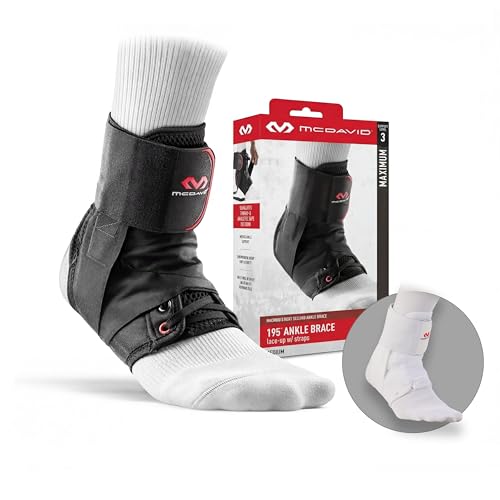
The McDavid 195 is the most structured pick in this roundup. It laces up like a shoe, then figure-8 straps wrap over the top to mimic the hold of an athletic tape job. For a karate student who wants the firmest feel during pivoting drills and jumping work, this one most limits side-to-side movement.
The body is a single layer of polyester, which keeps it slimmer than padded braces. It fits either the left or right ankle, so one purchase covers whichever side needs it. Because it is built to go inside athletic shoes, barefoot mat use means checking that the laces and strap ends sit flat. Tuck the ends down before you step on the mat.
Sizing runs from X-Small through X-Large on the listing, tied to ankle measurement, so measure and follow the chart. Putting it on takes a minute or two: laces first, then the straps. That routine feels slow for short drills, but for a full class with hard footwork it earns its place.
Specs:
– Brand: McDavid
– Model: 195, model number 195R-BK-M
– Material: Polyester
– Closure: Lace-up with figure-8 straps
– Fit: Left or right ankle
– Sizes on listing: X-Small, Small, Medium, Large, X-Large
TechWare Pro Ankle Brace Compression Sleeve

The TechWare Pro is the plain pull-on sleeve of the group. There are no laces and no straps: an elastic knit sock slides over the foot and gives even compression around the ankle and arch. For mat work, that smooth profile is the point. Nothing sticks up to catch on a partner or the mat.
The knit is a nylon and spandex blend, and the closure type on the listing is simply elastic, so fit comes from the fabric stretch. That makes sizing the whole game. A sleeve that is too large will slide during foot sweeps; one that is too small will feel harsh over a long class. Pick by measurement, per the maker’s size guidance.
This style gives the least structure of the five. It will not hold the joint the way a lace-up brace does. Where it shines is light daily training, warm-up rounds, and conditioning work where freedom of movement matters more than hold. It also packs flat in a gear bag, which makes it an easy spare to carry.
Specs:
– Brand: TechWare Pro
– Material: 80 percent nylon, 20 percent spandex
– Closure: Elastic pull-on
– Form: Compression sleeve with arch support
– Color on listing: Black
GARNO Ankle Brace Compression Sleeve with Adjustable Straps

The GARNO sits between a plain sleeve and a full brace. The base is a nylon compression sleeve, and adjustable hook-and-loop straps wrap over it so you can set the hold tighter for sparring drills and looser for kata practice. That middle path suits students who found a plain sleeve too soft but do not want to lace up before every class.
The listing describes a quick-adjust elastic strap system, and the brace is listed as one size fits most. One-size designs ask more of the straps: smaller ankles may run out of strap overlap, and larger ankles may find the sleeve snug before the straps close. Check the listing against your own measurement before ordering.
Keep the strap ends pressed flat. A loose strap tail can catch during groundwork and can mark a partner during close drills, so take a second to seat the straps before each round. The build also traps more warmth than a plain knit sleeve, which some students like in winter and others find heavy in summer.
Specs:
– Brand: GARNO
– Material: Nylon
– Design: Compression sleeve with adjustable straps
– Strap style: Quick-adjust elastic strap
– Size on listing: One size fits most
– Color on listing: Black
Honoson Kids Ankle Brace
The Honoson is the youth pick. It is a neoprene compression sleeve with an adjustable wrap, sized for children rather than shrunk from an adult pattern. Junior classes involve plenty of hopping, balance games, and early mat work, and a soft sleeve gives young students a snug layer without stiff panels.
This listing is a two-piece set, so both ankles can be covered or a spare can live in the gear bag. Neoprene holds warmth and has a smooth outer face that slides less against the mat than open knits. The trade-off is breathability: neoprene sleeves can feel warm in a long summer class, so air the set out and let it dry fully after training.
Fit for children needs an adult eye. A parent or instructor should check that the sleeve sits snug without marks on the skin and the wrap is firm but not overly tight. Children grow fast, so recheck the fit every few months and move up when the sleeve leaves deep lines or rolls at the edges.
Specs:
– Brand: Honoson
– Material: Neoprene
– Design: Breathable compression sleeve with adjustable wrap
– Age range on listing: Youth and child
– Pack count: 2 pieces
– Size on listing: Small
Modvel Foot and Ankle Brace Socks

The Modvel listing sells the sleeves as a pair, with two sleeves in the pack, one for each foot. Students who train both sides evenly get a matched feel during kata in a single order. The sleeves fit either foot, so there is no left and right to sort out in your bag.
The knit is a nylon and spandex blend with targeted compression zones around the arch and ankle and a shaped heel cup. It stays comfortable through long mat sessions, and the listing notes the sleeves are machine washable with air drying.
Like the other plain sleeves here, the Modvel gives compression rather than structure. It will not brace the joint against a hard roll the way the McDavid does. Think of it as the everyday training layer: warm-ups, forms practice, and light mat work where you want a snug, even feel on both feet without laces or straps.
Specs:
– Brand: Modvel
– Model: MV-151-M-SKIN
– Material: Nylon, spandex
– Pack count: Pair, 2 sleeves
– Fit: Either foot
– Care on listing: Machine washable, air dry
Who should skip
Skip ankle supports entirely if you have a fresh injury, ongoing swelling, or pain that changes how you walk. Those are signs to see a medical professional, not to shop for a brace. A support is not a treatment, and training through a real injury can turn a short layoff into a long one.
Skip the structured lace-up brace if your dojo does not allow braced gear during partner work, or if you mostly do gentle kata and want nothing between your foot and the mat. Skip one-size designs at either end of the size range, since the straps may not adjust far enough. And skip every pick here if you need a medical orthosis or a hinged brace; those are different products, chosen with professional guidance.
FAQ
Can I wear an ankle support barefoot on the mat?
Yes, sleeves and low-profile braces are commonly worn barefoot. Check that laces and strap ends sit flat, and ask your instructor first, because dojo rules on gear vary.
Will an ankle support stop me from getting hurt?
No. A support can add a snug, structured feel around the joint, but it is not a treatment and it cannot promise that you will avoid injury. Technique, warm-ups, and sensible training load matter far more.
How tight should an ankle support feel?
Snug and even, without numbness, tingling, or pinching. Follow the maker’s size chart and measure your ankle rather than guessing. If the support leaves deep marks or your foot changes color, it is too tight.
How do I care for an ankle support?
Wash or rinse it as the maker directs, then let it dry fully. Fabric stored damp in a gear bag breaks down faster, so air it out after every session.
Final verdict
Match the support to the work. Choose the McDavid 195 when you want the firmest, most structured hold for hard footwork. Choose the TechWare Pro sleeve for the slimmest barefoot feel, the GARNO when you want straps you can tune over a sleeve, the Honoson for younger students, and the Modvel pair when both ankles train every session. Measure first, follow the maker’s guidance, and clear it with your instructor before partner drills.
More from Amazon
Programs that pair well with the guide above. Offers and eligibility are set by Amazon and may change.
Free shipping on eligible items, Prime Video and more. Eligible new members can start with a free trial.
Start a Prime free trialA Prime membership for ages 18-24 with a trial period. Eligibility is set by Amazon.
See Prime for Young AdultsAudiobooks and podcasts to listen to on the go. Eligible new members can start with a free trial.
Try Audible freeAd-free music streaming. Eligible new subscribers can start with a free trial.
Try Music Unlimited freeAs an Amazon Associate we earn from qualifying purchases.


Write Your Review
No reviews yet. Be the first to share your experience!