

Key takeaways
- Compare five first aid kits sized for a dojo or home training space, with listed piece counts, case styles and restocking notes for minor scrapes.
Every training space needs a stocked first aid kit within easy reach, whether that space is a busy dojo running back-to-back classes or a garage floor where one person works through kata alone. Mats, wooden weapons and partner drills all bring the small knocks of regular practice: scraped knuckles, nicked shins, blisters and the odd small cut.
One point needs to be plain before any comparison. A first aid kit of the kind covered here is for minor scrapes and small cuts only. Anything serious, anything deep, and anything involving the head, neck or eyes needs professional care at once, not supplies from a box. With that boundary clear, the real buying questions are about size, case style, how the contents are organized, and how simple the kit is to check and restock.
As an Amazon Associate, we earn from qualifying purchases.
Quick answer
For most dojos, the First Aid Only 91248 is the strongest fit: 260 listed pieces in a clear-cover plastic case sized for a 50-person group, with contents visible at a glance. Home training spaces are usually better served by a smaller kit, such as the Johnson & Johnson 140-piece box or the SHBC 228-piece EVA case, while large halls can consider the 326-piece and 371-piece options.
How to choose
Match the kit to the number of people training
Piece count is the headline number on every listing, and it is also the easiest number to misread. A 260-piece kit does not cover 260 injuries; the count includes every single bandage, wipe and packet inside. What matters more is the person capacity the maker states and the mix of supplies behind the total. A solo home practitioner uses a handful of items across a whole season, while a dojo running children and adult classes on the same evening goes through bandages and antiseptic wipes far faster, and a kit listed for 50 or 100 people reflects that higher turnover.
Pick a case that suits the room
Hard plastic cases with clear covers suit a fixed spot on a dojo wall or shelf, because anyone can see what is inside and what is running low without opening the box. Wall-mountable designs keep the kit off the floor and in the same place every session, which matters when a junior instructor or a visiting parent has to find it quickly. Soft EVA cases suit home training spaces and gear bags, where the kit moves between a cupboard, a car and the training area. Whichever style you choose, the kit should live in one known place and stay dry.
Plan for checking and restocking
A kit is only useful if its contents are present and in date. Supplies get used one bandage at a time, and creams, wipes and medications carry dates that pass quietly while the box sits on a shelf. Build a simple habit: open the kit regularly, compare what is inside against the contents list, note anything used or out of date, and replace it before the next class.
Keep the boundary of the kit in mind
None of the kits in this guide turns a training space into a clinic, and none replaces trained help. Post emergency numbers where instructors can see them, keep a phone within reach of the training floor, and treat any injury beyond a minor scrape or small cut as a reason to stop and get professional care at once.
First Aid Only 91248 OSHA-Compliant First Aid Kit, 260 Pieces

This is the kit that fits the classic dojo setup: one box, mounted or shelved near the training floor, serving a full roster of students across a week of classes. The listing rates it for 50 people and counts 260 pieces, and the hard plastic case has a clear cover with slide latches, so a quick glance shows whether bandages or wipes are running low. Inside, the listing names bandages, gauze, burn cream, antibiotic ointment, BZK antiseptic towelettes, butterfly closures, disposable gloves, scissors and tweezers, a sensible spread for the minor scrapes and small cuts of regular training. The case measures 9.75 x 7.75 x 2.88 inches and weighs 1.5 pounds, compact enough for a shelf or the wall beside the mat area.
Specs:
- Brand: First Aid Only
- Model: 91248
- Listed pieces: 260
- Listed capacity: 50 people
- Case: plastic, clear cover, slide latches
- Dimensions: 9.75 x 7.75 x 2.88 inches
- Weight: 1.5 pounds
- Named contents: bandages, gauze, burn cream, antibiotic ointment, antiseptic towelettes, butterfly closures, gloves, scissors, tweezers
Be Smart Get Prepared First Aid Kit, Hard Red Case, 326 Pieces

Schools with large memberships, or a dojo that shares a hall with other clubs, may want the extra headroom of this 326-piece kit. The listing rates it for 100 people and states that it meets and exceeds OSHA and ANSI guidelines, and the hard red case is easy to spot across a room, a genuine virtue when someone is sent to fetch it in a hurry. The manufacturer is Total Resources International, and the case is described as wall-mountable for a fixed, known location. The trade-off is turnover: a kit this large holds many dated items, so the regular contents check matters even more, and a small home training corner will likely never work through its supplies before dates pass.
Specs:
- Brand: Be Smart Get Prepared
- Manufacturer: Total Resources International
- Model: 20HBC01015REV3
- Listed pieces: 326
- Listed capacity: 100 people
- Case: hard case, red, wall-mountable
- Listing states: exceeds OSHA and ANSI guidelines
RHINO RESCUE 371 Pieces OSHA All-Purpose First Aid Kit

RHINO RESCUE takes a different approach to the fixed dojo kit. Its 371 listed pieces sit in a box with tilting shelves and a transparent lid, a layout borrowed from workshop organizers, so supplies stay separated and visible rather than layered in one compartment. The listing rates the kit for 100 people and describes the box as wall-mountable, with a handle for carrying it to the training floor when needed. Named components include antiseptic, bandages, burn ointment, an instant cold pack and a tourniquet, alongside assorted gauze pads, tapes and gloves. The box weighs 3 pounds, with package dimensions listed as 12.9 x 11.57 x 4.02 inches, so it needs more wall or shelf room than the First Aid Only case.
Specs:
- Brand: RHINO RESCUE
- Model: RR-L
- Listed pieces: 371
- Listed capacity: 100 people
- Case: box with tilting shelves and transparent lid, wall-mountable
- Weight: 3 pounds
- Package dimensions: 12.9 x 11.57 x 4.02 inches
- Named components: antiseptic, bandage, burn ointment, cold pack, tourniquet
Johnson & Johnson All-Purpose Portable Compact First Aid Kit, 140 Pieces
For a home training space, this smaller kit is often the sensible scale. The listing counts 140 pieces in a durable plastic box, aimed at minor cuts, scrapes, sprains and burns, and the contents lean on familiar Johnson & Johnson brands, with Band-Aid brand adhesive bandages, Neosporin and Tylenol named among the supplies. The listed contents include cleansing wipes, gauze pads, assorted bandages, rolled gauze, antibiotic cream, itch stopping cream, acetaminophen caplets, an instant cold pack, two pairs of gloves and a first aid guide. That mix suits the solo practitioner or a parent whose child trains at home, where incidents are small and infrequent.
Specs:
- Brand: Johnson & Johnson
- Listed pieces: 140
- Case: durable plastic box
- Named contents: cleansing wipes, gauze pads, bandages, rolled gauze, antibiotic cream, itch stopping cream, acetaminophen caplets, instant cold pack, gloves, first aid guide
- Brands named in the listing include Band-Aid, Neosporin and Tylenol
- Listing notes: contents may vary
SHBC Compact First Aid Kit, 228 Pieces
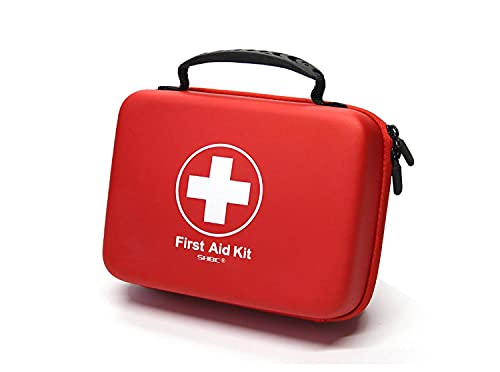
The SHBC kit suits training spaces that are not permanent. Its 228 listed pieces sit in an EVA case that the listing describes as waterproof, in a red finish that stands out in a gear bag or a car boot. That portability matters for instructors who teach in rented halls, run outdoor sessions, or train at home in a space that has to return to family use afterwards. The listing frames it as a family emergency kit for home, car, school, camping, hiking, office and sports use, which matches the way many martial artists train across the week: a class here, solo practice there, a seminar somewhere else.
Specs:
- Brand: SHBC
- Listed pieces: 228
- Case: EVA, described in the listing as waterproof
- Color: red
- Framed in the listing for: home, car, school, camping, hiking, office and sports
Who should skip
Skip every kit in this guide if you are looking for supplies for serious injuries. Deep wounds, head or neck injuries, suspected fractures and anything involving the eyes need professional care at once, and no stocked box changes that. Skip the large 100-person kits if you train alone at home, since dated items will expire long before you use them. Skip soft cases if your kit will live permanently on a dojo wall, where a hard, clear-cover case is easier to check at a glance. Finally, skip the purchase if nobody in your space will take responsibility for checking dates and restocking used items.
FAQ
How many pieces does a dojo first aid kit actually need?
There is no single right number, because piece counts include every individual bandage and wipe. A quiet home training space is well served by a kit in the 140 to 230 piece range, while a dojo running daily classes for dozens of students should look at kits listed for 50 or 100 people.
Where should the kit be kept in a training space?
Keep it in one fixed, known place that everyone who trains there can reach quickly: mounted on a wall near the training floor, or on a low shelf by the entrance. It should stay dry and never be buried under mats or gear.
How often should the contents be checked?
Check the kit on a regular schedule, such as once a month for a busy dojo and once a season for a home space, and also after any session where supplies were used. Compare the contents against the list on the box, replace anything used, and remove anything past its date. Naming one person to own that job keeps it from being missed.
Can a first aid kit replace first aid training?
No. A kit is a box of supplies, and it does not judge how serious an injury is or decide what should happen next. Dojos benefit from having at least one instructor with current first aid training, and every training space should have emergency numbers posted and a phone within reach.
Final verdict
For a working dojo, the First Aid Only 91248 offers the best balance of capacity, visibility and size, with the Be Smart Get Prepared 326-piece case and the RHINO RESCUE 371-piece box as larger alternatives for halls serving up to 100 people. For home training spaces, the Johnson & Johnson 140-piece box and the portable SHBC 228-piece case are easier to keep current and simpler to store. Whichever you choose, the kit earns its place only if it stays in a known spot and is restocked as items are used.

More from Amazon
Programs that pair well with the guide above. Offers and eligibility are set by Amazon and may change.
Free shipping on eligible items, Prime Video and more. Eligible new members can start with a free trial.
Start a Prime free trialA Prime membership for ages 18-24 with a trial period. Eligibility is set by Amazon.
See Prime for Young AdultsAudiobooks and podcasts to listen to on the go. Eligible new members can start with a free trial.
Try Audible freeAd-free music streaming. Eligible new subscribers can start with a free trial.
Try Music Unlimited freeAs an Amazon Associate we earn from qualifying purchases.


Write Your Review
No reviews yet. Be the first to share your experience!