

Key takeaways
- Ten interlocking EVA foam puzzle mats compared by thickness, tile count and square footage, with advice on sizing a home karate practice floor for kata.
Half-inch EVA tiles, like the ProsourceFit 48 sq ft set, are the safest default for stances, kata and kicks at home, because they stay firm underfoot. Thicker one-inch sets add cushioning, and only the Gold BJJ 1.5-inch listing is sold for throws. None of these titles promise karate suitability. This roundup sorts ten interlocking foam listings by thickness, coverage and who each one actually fits.
Quick picks
Our top picks





As an Amazon Associate we earn from qualifying purchases at no extra cost to you.
- Best default floor: ProsourceFit ½-inch, 48 sq ft
- Best for solo kata room: ProsourceFit weaved or BalanceFrom 1-inch, 72 sq ft
- Best for throws and falls: Gold BJJ 1.5-inch
- Not a full floor: CAP single tile, AIRHOP thin liner
Comparison table
| Model | Key point from title | Best for |
|---|---|---|
| ProsourceFit ½-in 48 sq ft | 12 tiles, black | Default floor |
| Gold BJJ 1.5-in, 33 sq ft | Grappling mat | Throws and falls |
| CAP Barbell single tile | Single tile | Sampling the foam |
| ProsourceFit ½-in 144 sq ft | 36 gray tiles | Whole room |
| ProsourceFit weaved 1-in 24 sq ft | 6 black tiles | Corner basics |
| ProsourceFit ½-in 24 sq ft | 6 black tiles | Starter patch |
| ProsourceFit weaved 1-in 72 sq ft | 18 black tiles | Solo kata space |
| BalanceFrom 1-in, 72 sq ft | 24 x 24 x 1 in tiles | Stated dimensions |
| ProsourceFit rubber top | Blue, rubber surface | Shared gym room |
| AIRHOP 0.4-in, 18 pieces | 12.6 in tiles | Thin liner |
Each mat in detail
ProsourceFit Puzzle Mat ½-Inch, 48 Sq Ft (12 Tiles, Black)
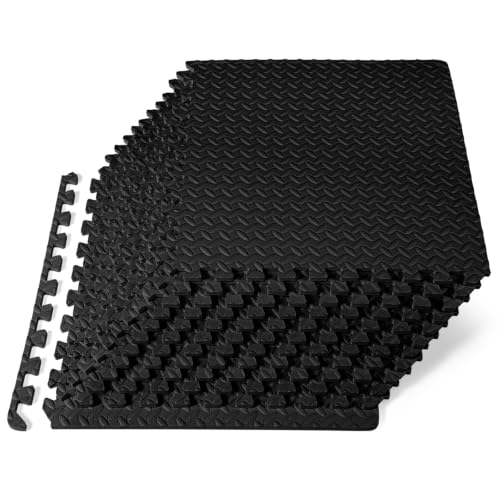
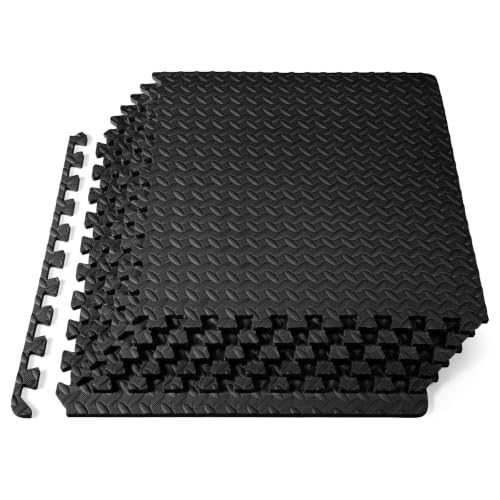
This is the baseline listing: half-inch EVA interlocking tiles in black, twelve of them covering 48 square feet, marketed for home gyms, workout equipment and kids’ play areas. Karate is not mentioned, so treat it as general exercise flooring. The numbers work out to 4 square feet per tile, so the set makes a rectangle of roughly 6 by 8 feet, enough for kihon lines or a compact kata. Half an inch softens a hard floor without turning it into a dojo surface.
Pros
- Generous 48 sq ft coverage
- Same line as larger and smaller sets, so expanding later is easy
Cons
- Only half an inch thick
- Not designed for martial arts per the title
Who it’s for: a home karateka with a spare room corner who mainly does basics, stances and kata.
Gold BJJ Home Jiu Jitsu Mats, 1.5 Inch, 33 Sq Ft
The only listing aimed at martial arts: extra-thick 1.5-inch interlocking mats for grappling, wrestling, MMA and judo, in black and grey, covering 33 square feet. That thickness is built for falls and throws, which most karate practice does not need, and deep foam can make stance work feel wobbly underfoot. Thirty-three square feet is also a modest area, about 5.7 feet on a side if laid square. It is typically the priciest listing per square foot among the larger sets. Ask your instructor whether a floor this soft helps or hinders your style before you buy.
Pros
- Marketed specifically for martial arts floors
- Extra-thick 1.5-inch cushioning
Cons
- Deep foam can feel unstable for stances and pivots
- Small coverage for the thickness
Who it’s for: karate students who also drill breakfalls, throws or ground work and accept the trade-off.
CAP Barbell ½-Inch Puzzle Mat, Single 24 x 24 Inch Tile
Read the title closely: this is a one-pack of a single 24 by 24 inch tile, half an inch thick, in a black T pattern. One tile covers 4 square feet, far too little for a practice floor on its own. Its best use is as a low-cost sample to feel the foam and interlock before ordering a big set, or as a patch piece. Mixing brands is a gamble, because tab shapes and edges are not guaranteed to fit each other.
Pros
- Inexpensive way to sample the foam
- 24-inch size is easy to plan around
Cons
- One tile covers only 4 sq ft
- Cross-brand fit with other sets is uncertain
Who it’s for: anyone sampling the material or filling a gap, not a person building a full practice floor.
ProsourceFit Puzzle Mat ½ Inch, 144 Sq Ft (36 Tiles, Gray)
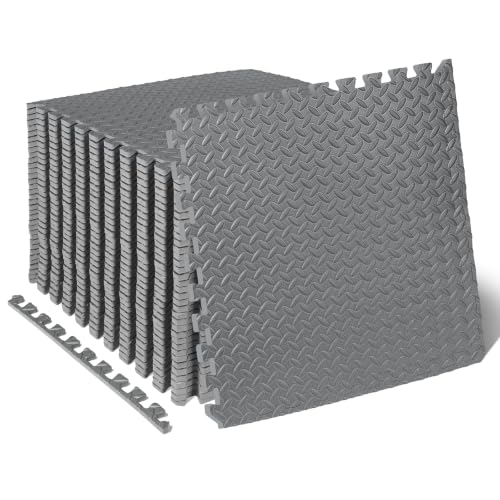
The largest coverage here: 36 half-inch tiles in gray for 144 square feet, about 12 by 12 feet if laid square. That is a whole garage bay or spare room, with space for two people to work partner drills at a respectful distance. The title does not mention border pieces, so check the listing for edge strips. Half-inch thickness again means firm footing and modest cushioning, which many people prefer for footwork. Check where doors and furniture will cut into the grid, and plan storage for the spare pieces.
Pros
- Floors an entire room in one purchase
- Firm half-inch surface suits footwork
Cons
- Thin cushioning for falls
- Thirty-six pieces are slow to lay and store
Who it’s for: families or small groups turning a whole room or garage into a training space.
ProsourceFit Weaved Extra Thick 1-Inch, 24 Sq Ft (6 Tiles, Black)
A one-inch weaved-pattern set with six tiles covering 24 square feet, described as protective, cushioned flooring for home and gym equipment. The weave is a surface-texture choice that may change how bare feet slide during turns, though the title says nothing about grip. Twenty-four square feet is just under 5 by 5 feet, a small square for stances and basics in place. It is general-purpose flooring, not a martial arts product. Because the grid is only six tiles, there is no room to spare if you also want to place a bag or stand.
Pros
- Thicker one-inch build
- Six tiles are quick to lay
Cons
- Only 24 sq ft of space
- Marketed for equipment protection, not karate
Who it’s for: practitioners with a tiny corner who want extra padding for conditioning and kicking drills.
ProsourceFit Puzzle Mat ½-Inch, 24 Sq Ft (6 Tiles, Black)
The entry-level cousin of the 48 sq ft set: half-inch EVA, six tiles, 24 square feet, black, for home gym, workout equipment and kids’ play. It is the smallest ProsourceFit option and the cheapest way to carve out a practice patch in a corner. Because it belongs to the same line as the bigger sets, you can start here and add more later, though check the listing for any difference in batch or color between purchases. Leave a buffer between tiles and nearby walls, and keep it as a low-cost way to start.
Pros
- Low commitment for beginners
- Expandable with the same line
Cons
- Just 24 sq ft of coverage
- Half-inch only, so limited cushioning
Who it’s for: a newcomer finding out whether home practice sticks before spending on a larger floor.
ProsourceFit Weaved Exercise Puzzle Mat, 1 In, 72 Sq Ft (18 Tiles)
One-inch weaved tiles, eighteen of them in black, covering 72 square feet, or roughly 8.5 by 8.5 feet if square. That may be enough room for the straight-line patterns in many solo kata without taking over a whole room. One inch gives twice the cushion of the half-inch sets while staying thinner than judo-style mats. The title does not state a grip or texture rating, so check buyer comments on how bare feet behave. Square tiles leave stepped edges for diagonal kata, so weigh seams against room.
Pros
- Useful 72 sq ft footprint in a one-inch build
- Weaved top gives a distinct surface texture
Cons
- More tiles mean more seams
- Not built for throwing practice
Who it’s for: solo practitioners who want more padding than half-inch tiles but still need room to move.
BalanceFrom Puzzle Exercise Mat, 1 Inch, 72 Sq Ft (18 Tiles)
A direct rival to the weaved ProsourceFit 72 sq ft set. BalanceFrom’s title states exact tile dimensions: 24 by 24 by 1 inch EVA foam, eighteen tiles, black, with floor padding for kids mentioned. The title names no pattern, so compare edge borders and thickness consistency on the listing before choosing between the two. Exact tile sizes make layout planning easier, and the choice may come down to return terms and buyer comments about edge fit. Read the seller’s return terms if the fit looks off, and look for border pieces.
Pros
- Exact tile dimensions in the title
- One-inch thickness with 72 sq ft
Cons
- Title does not mention border pieces
- Little to separate it from the weaved rival
Who it’s for: shoppers comparing 72 sq ft sets who like stated dimensions.
ProsourceFit Rubber Top Puzzle Mat ½-Inch, 48 Sq Ft (Blue)
A rubber-top variant: half-inch EVA foam with a rubber surface layer, twelve blue tiles, 48 square feet, intended for protecting floors under home gym equipment. A harder rubber top behaves differently under bare feet during pivots than soft foam, but the title does not say how, so read buyer comments on grip before ordering. Blue also marks the training zone clearly in a shared room. Consider bare-skin comfort too if you plan any floor work, and check the listing for how thick the rubber layer is and whether edges are included.
Pros
- Rubber top surface
- Distinct blue color marks the practice area
Cons
- Surface feel on bare feet is unknown from the title
- Aimed at heavy equipment, not martial arts
Who it’s for: households that share the floor with a weight bench or exercise bike.
AIRHOP 18-Piece Gym Floor Mat, 12.6 x 12.6 x 0.4 Inch
Eighteen small tiles measuring 12.6 by 12.6 inches and only 0.4 inch thick, sold for gym, play, garage and kitchen flooring. Total coverage works out near 20 square feet, and the smaller pieces mean many seams that can catch toes during sliding steps. It is the thinnest option here and behaves more like a floor liner than a training mat, though its small tiles do fit awkward corners. Do not expect it to absorb impact; its job is to take the edge off a bare concrete or tile surface. Check whether edge borders are included.
Pros
- Small tiles fit tight spaces
- Light and easy to stash
Cons
- Just 0.4 inch thick
- Many seams across a small area
Who it’s for: garage or hallway practice where a thin liner is all that’s needed.
How we picked these
We built this list from the listing titles, published specifications, manufacturer documentation and buyer reviews, keeping only interlocking foam floor tiles that a home practitioner could realistically use. Square footage and thickness come straight from titles. Nobody on the team used or measured these units. Ten listings made the cut, and each is described only as far as its title allows. Anything unclear or missing is flagged so you can check it yourself on the product page.
What to look for in puzzle mats for home karate
Thickness decides how the floor feels
Karate involves pivots, sliding steps and quick weight changes. Thin half-inch foam feels closer to a hard floor and keeps footing predictable. One-inch foam cushions better for conditioning but may feel soft during stance work. Anything near 1.5 inches is built for grappling and falls. If a tile feels spongy under a heel, balance suffers on single-leg techniques like kicks.
Tile size and coverage math
Most listings use 24-inch squares, so each tile covers 4 square feet. Divide the square footage you want by four to find the tile count. Smaller tiles, like the 12.6-inch AIRHOP pieces, add more seams per square foot. Also leave room around the mat for warm-up and for stepping off, because running out of floor mid-technique is how ankles get twisted.
Surface and edges
Smooth, textured and rubber-topped surfaces change how bare feet grip. Check whether border strips are included, because exposed tab edges can catch toes. Keep the mat on a clean, flat floor and never over loose rugs. Dry your feet before practice, since sweat on foam is slippery.
Match the floor to what you train
Kihon and kata reward a stable, predictable base, so half-inch tiles usually suit them. Conditioning, push-ups and stretching favor one inch. Partner drills need space for two. If your style includes throws, only the Gold BJJ listing is pitched at that, and you should still take instruction on falling.
Worked example: sizing a kata floor
Say your kata travels about six feet forward and two feet sideways. Add a one-foot margin all round and you need an 8 by 4 foot area, or 32 square feet. With 4 square foot tiles that is eight tiles, so a 6-tile set falls short and a 12-tile set leaves room to spare. Tape the pattern on your floor first and count tiles before you buy. If your room is a few inches off, interlocking tiles can usually be trimmed or left with a small gap, so check the listing for border pieces.
Mistakes buyers make
Buying a single tile expecting a floor. Choosing thick foam for stance work. Mixing brands and finding the tabs do not match. Ignoring the margin around a kata. Laying tiles over a rug. Treating foam as protection for hard contact. Forgetting that a mat on carpet will creep and tilt. Buying by color alone. Skipping a test lay-out before committing to the full order. For anything involving falls or throws, ask an instructor before relying on a home setup, and keep children and pets off the practice floor.
Verdict
Start with the ProsourceFit ½-inch 48 sq ft set for general practice. Move to the 72 sq ft one-inch sets if you want more padding and space, and consider the Gold BJJ only if throws are part of your training. Skip the single CAP tile and the thin AIRHOP set unless you only need a small patch or a liner. Whichever you choose, confirm tile counts first.
Related guides
- Century Martial Arts Karate Sparring Gear
- How To Wash A Karate Gi Without Shrinking It
- Lightweight Karate Gi For Kata
Frequently asked questions
Are puzzle mats suitable for karate practice?
They suit basics, stances, kata and conditioning on a flat floor, but only the Gold BJJ listing is marketed for martial arts. Soft foam can make pivots feel unsteady, so ask your instructor first.
How thick should foam mats be for karate?
There is no single answer. Half-inch tiles give a firmer base that many find easier for footwork, while one-inch and thicker tiles add cushioning for conditioning and falls. If you never practice falls, thinner is usually less wobbly. Choose thickness by what you actually train.
How many tiles does a kata need?
It depends on the kata and your stride, so mark the pattern on the floor with tape first. A 6 by 8 foot area needs twelve 2-foot tiles, and an 8.5 by 8.5 foot area needs eighteen. Add a margin so you do not step off the edge mid-form.
Will puzzle mats slide on a hard floor?
They can shift on smooth floors, especially under turning feet. Lay them on a clean, flat, dry surface, check that tiles stay locked together, and avoid laying them over loose rugs. Some listings mention textured tops, but the titles here do not guarantee grip.
Can puzzle mats handle sparring or throws?
Foam exercise tiles are not designed for hard contact and can separate at the seams. If your training includes falls, discuss proper mats and technique with your instructor. Foam reduces floor hardness but does not remove injury risk.



Write Your Review
No reviews yet. Be the first to share your experience!