

Key takeaways
- Wipe down after use. Sweat and skin oils break down leather and synthetic coatings. A damp cloth with mild soap is enough.
- Air them out. Do not store pads in a sealed bag. Hang them or lay them flat in a ventilated place.
- Condition leather occasionally. A light leather conditioner every few months keeps cowhide from drying and cracking.
- Check the straps. Replace worn straps before they fail mid-round.
- Do not use pads on a wet floor. Moisture seeps into foam through the seams and speeds up breakdown.
The best Muay Thai pads for most gyms and home trainers in 2026 are the Fairtex KPLC2 curved pads for all-round durability, the Twins Special KPL-12 for lighter holding, and the Hayabusa PTS3 for a premium synthetic alternative. If you hold pads for many students per day, a lighter model such as the Fairtex KPLC5 or KPLC6 will save your forearms. If you are buying for a single training partner, a classic cowhide pair is the safer long-term choice.
Muay Thai pads, also called kick pads or Thai pads, are curved, thick pads strapped to the forearms so a holder can absorb kicks, knees, elbows and punches. They are different from boxing focus mitts: they are bigger, deeper and built to take full-power shin strikes. The right pair protects the holder, gives the striker honest feedback, and survives hundreds of rounds. This guide compares seven real models, explains padding depth and weight trade-offs, and shows how to care for them.
Our top picks


As an Amazon Associate we earn from qualifying purchases at no extra cost to you.
Quick Comparison of the Seven Picks
| Pick | Best for | Material | Reported weight | Notable feature |
|---|---|---|---|---|
| Fairtex KPLC2 Curved | All-round gym standard | Cowhide leather | About 2.2 to 2.7 kg per pair | Hand-made in Thailand, curved shape |
| Fairtex KPLC5 Lightweight | Coaches who hold all day | Syntek leather | About 1.9 kg per pair | Extra forearm pad |
| Fairtex KPLC6 | Ergonomic fit, lighter build | Synthetic with fiber filling | Roughly 100 g lighter than older models | Ergonomic curve |
| Twins Special KPL-12 | Compact, quick-moving holders | Cowhide leather | Roughly 1.8 lb per pad | Firm foam about 2.2 in deep |
| Hayabusa PTS3 | Premium synthetic option | Vylar vegan leather, 5-layer EVA foam | 2.7 lb as listed by the brand | Wide straps, metal buckles |
| Venum Giant Kick Pads | Beginners, heavy kickers | Skintex synthetic leather | Varies by listing | Large target, multi-density foam |
| Top King Ultimate | Curved Thai-style feel | Leather | Roughly 2.1 lb per pad in small and medium | Ergonomic curve, multiple sizes |
Weights and dimensions are taken from manufacturer pages and retailer listings, and the sources disagree in places, especially on whether a figure is per pad or per pair. Check the listing you are buying from.
Best Overall: Fairtex KPLC2 Curved Pads
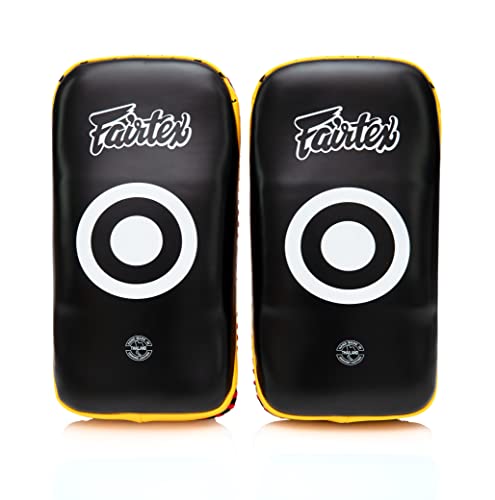
The Fairtex KPLC2 is the pair you will see in the majority of Thai camps and Western gyms, and for good reason. It is made of cowhide leather, hand-made in Thailand, with a curved shape that matches the arc of a roundhouse kick. Retailer listings put the weight at roughly 2.2 to 2.7 kilograms per pair, with dimensions around 38 by 20 by 10 centimeters, so each pad is a substantial block of foam.
Who it suits: gym owners, coaches and serious students who want one pair that will last for years. The deep foam protects the holder against full-power kicks, and the leather develops a firm, predictable surface.
Pros: proven durability, great shock absorption, long reputation. Cons: the heft tires the arms during long holding sessions, and unlike some newer models the KPLC2 does not have extra forearm padding, so holders may want a forearm guard for heavy kickers.
Best for Long Holding Sessions: Fairtex KPLC5 Lightweight
The Fairtex KPLC5 keeps the curved design but swaps the heavy cowhide for Syntek leather, bringing the pair down to around 1.9 kilograms. It adds an extra forearm pad, which gives a measurable comfort bump when you are holding for an hour straight. The lighter shell also lets you move the pads faster between strikes, which is what makes combinations feel realistic.
Who it suits: coaches who teach several back-to-back classes and holders who do not want sore forearms by the end of the day.
Pros: less fatigue, forearm padding, fast to move. Cons: Syntek leather will not age like real cowhide, and very hard kickers can feel the lighter foam more than they would on a deeper pair.
Best Ergonomic Fit: Fairtex KPLC6
The KPLC6 is positioned as the next step in the lighter-pad line. Retailers describe it as about 100 grams lighter than the original models, with a curved, ergonomic shape and odorless fiber filling. The design is aimed at trainers who find standard pads bulky and want a closer, more comfortable fit on the forearm.
Who it suits: smaller holders, trainers with wrist or shoulder fatigue, and anyone who values a more form-fitting pad.
Pros: slim profile, comfortable fit, quieter hit sound. Cons: less foam depth than a classic pair, so heavy-hitting students may overwhelm the pad faster, and fewer long-term durability notes exist because it is a newer design.
Best Compact Pad for Quick Feedback: Twins Special KPL-12
Twins Special is a long-standing Thai brand, and the KPL-12 is known for a more compact shape. It uses cowhide, a moderate curve and firm foam that reviewers describe as about 2.2 inches deep, with roughly 1.8 pounds per pad. That makes it slightly lighter and smaller than the Fairtex KPLC2, which coaches who hold for many students appreciate.
Who it suits: holders who like a snappy, responsive pad and teachers who need to shift position quickly.
Pros: lighter than standard curved pads, authentic cowhide, firm feel. Cons: the smaller target is less forgiving for beginners with poor accuracy, and the firm foam transmits more impact if the striker is very powerful.
Best Premium Synthetic: Hayabusa PTS3
The Hayabusa PTS3 Thai pads use five layers of EVA foam inside a Vylar vegan-leather shell, with riveted and reinforced grips, wide straps and metal buckles. Hayabusa lists the pads at 14 inches high, 8 inches wide and 3.5 inches deep, with a weight of 2.7 pounds. Retailers disagree about whether that figure is per pad or per pair, so treat it as a ballpark.
Who it suits: buyers who want a modern look and consistent construction without choosing a traditional leather pad. Some reviewers describe it as a premium option for people who do not want to pay for the Fairtex name.
Pros: layered foam, low-profile build, strong hardware. Cons: synthetic shells tend to show wear at the seams before cowhide does, and the price sits in the premium band.
Best for Beginners and Heavy Kickers: Venum Giant Kick Pads
The Venum Giant Kick Pads use Skintex synthetic leather and multi-density foam designed to absorb shock. They are a one-size pad with a large target area, which makes them forgiving for beginners who are still learning distance and timing. Some retailers list a padding depth near four inches, which is thick and protective but also makes the pad heavier on the arm.
Who it suits: new students, home trainers and anyone holding for a heavy-hitting partner.
Pros: large target, thick padding, accessible price tier. Cons: synthetic leather will not last as long as cowhide, and the bulk can slow down fast-paced pad work.
Best Thai-Style Curve with Size Options: Top King Ultimate
Top King Ultimate pads, listed as the TKKPU, are ergonomically curved and are sold in several sizes. Retailer data lists the small and medium at about 2.1 pounds per pad, and the small at around 14 by 8.5 by 5 inches. Because the sizes vary, you can match the pad to the holder’s frame, which is rarely possible with a single standard size.
Who it suits: gyms with a mix of adult and smaller holders, and buyers who want the feel of a traditional Thai pad.
Pros: size options, curved shape, Thai-style construction. Cons: published weights contain inconsistencies, so double-check the listing for the size you plan to order.
How to Choose Muay Thai Pads
Padding depth against weight
Padding between two and three inches protects the holder’s forearm from heavy kicks, while a lighter one to one-and-a-half inch pad gives faster feedback to the striker. The deeper the pad, the heavier it feels after the third round. A good rule is to buy depth if you hold for hard hitters and buy lightness if you hold for volume.
Leather against synthetic
Fairtex and Twins use Thai cowhide, which gets firmer and more stable with age. Venum’s Skintex and Hayabusa’s Vylar are synthetic and tend to cost less and be easier to clean, but they can scuff and crack sooner. For a pair that will serve a gym for five years, cowhide is the standard choice.
Straps and grips
Look for dual forearm straps with Velcro and a strong handle. Loose straps cause the pad to rotate on impact, which is one of the quickest ways to hurt a wrist. Metal buckles, as on the Hayabusa, hold better than hook-and-loop alone under repeated shock.
Sizing and weight worked example
Suppose you teach four 45 minute classes in a row and hold for about 30 minutes of each. That is two hours of holding. A pair that weighs 2.5 kilograms puts roughly 1.25 kilograms on each arm; a pair at 1.9 kilograms puts about 0.95 kilograms on each. Over two hours, the difference is noticeable, and many coaches find it is the difference between finishing the day fresh and needing a rest day.
Decision Matrix by Situation
| Your situation | Choose | Why |
|---|---|---|
| Gym owner, one pair for years | Fairtex KPLC2 | Cowhide durability and shock absorption |
| Teaches many classes a day | Fairtex KPLC5 or KPLC6 | Lower weight, extra forearm comfort |
| Fast, compact holding | Twins Special KPL-12 | Smaller firm pad |
| Wants a modern synthetic | Hayabusa PTS3 | Layered EVA foam, wide straps |
| Beginner or home partner | Venum Giant Kick Pads | Large target and thick foam |
| Mixed adult and youth classes | Top King Ultimate | Several sizes |
Care, Durability and Common Mistakes
- Wipe down after use. Sweat and skin oils break down leather and synthetic coatings. A damp cloth with mild soap is enough.
- Air them out. Do not store pads in a sealed bag. Hang them or lay them flat in a ventilated place.
- Condition leather occasionally. A light leather conditioner every few months keeps cowhide from drying and cracking.
- Check the straps. Replace worn straps before they fail mid-round.
- Do not use pads on a wet floor. Moisture seeps into foam through the seams and speeds up breakdown.
Common mistakes include buying the lightest pad for a heavy-kicking partner, ignoring wrist support, and overlooking size. A pad that is too large for a smaller holder forces awkward angles that cause shoulder and elbow strain. Wearing a forearm guard under the strap and keeping your elbows tucked on impact reduces the risk of injury.
As a rule, a quality pair of cowhide pads used by a single gym for several classes a day will show wear in the leather after two to three years, but the foam often stays serviceable much longer. If the foam has flattened, replace the pads rather than adding tape over the problem, because compressed foam stops absorbing kicks.
Safe Holding Technique Matters as Much as the Pad
Even the best pads cannot save a holder with poor technique. Keep your elbows close to your ribs, brace your core before every kick, and rotate your hips slightly into the strike so the force is absorbed by the body rather than the arm. Present the pad at the correct angle: flat for roundhouse kicks, tilted slightly down for low kicks, and held close to the chest for knees. If you are new to holding, ask an experienced coach to correct your stance before you attempt heavy rounds. Holders who tense their shoulders and brace with only the arms are the ones most likely to end up with sore wrists and elbows.
Pad Types Beyond the Curved Kick Pad
A complete Muay Thai pad setup is more than one pair of arm pads. Understanding the other pieces helps you decide whether a single pair is enough or whether a small kit makes more sense.
- Belly pads: a thick body protector worn by the holder so students can practise teeps, knees and body kicks. Brands such as Yokkao and Fairtex make them, and they take pressure off your forearms during close-range knee drills.
- Suitcase or low-kick pads: a long single pad with a reinforced handle designed to be held upright against the thigh for low kicks. Yokkao lists a Suitcase Low Kick Pad with microfiber leather and reinforced handles.
- Elbow pads: small, padded targets for practising elbow strikes with control.
- Freestyle or institution pads: flatter, lighter pads from brands such as Yokkao that suit mixed striking classes and group sessions.
For most home trainers, one pair of curved arm pads plus a belly pad covers about ninety percent of the drills worth doing. A gym will usually add suitcase pads once low-kick volume becomes high.
Three Drills That Show Whether Your Pads Fit
- Single roundhouse kicks at 50 percent power. Hold the pad at shoulder height and check that the pad does not rotate on your forearm. Rotation means the strap needs tightening or the pad is too big for your arm.
- Teep and knee sequences. Hold the pad against your abdomen or at chest height. If the pad feels like it slams into your ribs, move up to a belly pad or a deeper curved pair.
- Three-round combination rounds. After the third round, notice whether your forearms are burning. If they are, a lighter pair, a forearm guard or a shorter holding time is the answer.
Rotate holders if you have a group so nobody holds for more than a few rounds at full power. Pad fatigue leads to sloppy form, and sloppy form causes the injuries that cheap or ill-fitting equipment is usually blamed for.
Budget Planning for a Small Home Setup
If you are starting from nothing, plan the purchase in stages. Begin with one quality pair of curved pads, since they are the item that wears the most. Add a belly pad when you start drilling knees and teeps, and add forearm guards if your holder has sore arms after sessions. Buying a premium pair first and cheap extras later is a better use of money than splitting the budget across low-quality items that all need replacing in a year.
It also helps to think in terms of cost per hour. A pair of cowhide pads used for two hours a week lasts roughly 100 hours per year, and a decent pair can run for five years or more, which spreads the cost over 500 hours. A cheaper synthetic pair that needs replacing every two years works out to about 200 hours per pair. Looking at total hours rather than the sticker price makes the case for quality pads clearer, especially for coaches who hold daily.
Frequently Asked Questions
What is the difference between Thai pads and focus mitts?
Thai pads are thick, curved pads strapped to the forearms to absorb kicks, knees and elbows. Focus mitts are smaller hand pads designed for punches and quick combinations. Using mitts to catch heavy kicks is unsafe.
Are curved Thai pads better than flat ones?
Curved pads match the natural arc of a kick, which spreads impact more evenly and reduces the chance of the shin sliding off the edge. Most trainers prefer curved pads for Muay Thai, while flat pads still appear in some kickboxing programs.
How heavy should Thai pads be?
Most pairs fall between roughly 1.9 and 2.7 kilograms. Lighter pairs reduce fatigue for coaches holding all day, and heavier pairs usually offer deeper protection against hard kicks.
How long do Muay Thai pads last?
Quality cowhide pads often last several years in regular gym use. Synthetic pads may need replacing sooner, especially if the seams or straps show wear. Replace any pair whose foam has compressed noticeably.
Can beginners use Thai pads at home?
Yes, but both people should learn basic holding technique first. Start with light-contact drills, use a forearm guard, and avoid full-power kicks until the holder is comfortable.


Write Your Review
No reviews yet. Be the first to share your experience!