

Key takeaways
- Power stretcher: Essential for large rooms; a kicker is a complement, not a replacement.
- Stair stretcher: Models like the Crain 507 are made for stairs where a standard kicker is awkward.
- Rental tools: If you only need a stretcher once, renting a power stretcher and buying only an economy kicker can be sensible.
- Professional installation: For stretched wall-to-wall installs on large floors, hiring a fitter avoids buying tools you may not use again.
For most carpet installers, an adjustable-length kicker with a die-cast aluminum body and a replaceable bumper, such as the Roberts Deluxe 10-412, is the safe default, while professionals who stretch all day often prefer a wide-head model like the Crain 505, and homeowners with a single room to do can get by with a fixed-length economy kicker. The right choice depends on how many rooms you will stretch, the carpet backing, your height, and how much the tool will be used.
Our top picks


As an Amazon Associate we earn from qualifying purchases at no extra cost to you.
Carpet Knee Kickers at a Glance
| Model | Best for | Key stated specs | Limits |
|---|---|---|---|
| Roberts Deluxe 10-412 (10-412-2) | Professional-grade general use | Adjustable 17 to 21 inches, die-cast aluminum body, foam-filled seamless bumper, checkered non-slip grip, about 4.8 lb; the maker calls it an industry standard for durability and comfort | Some installers report deformation or padding complaints; higher cost than economy options |
| Roberts Adjustable 10-410 | Light to moderate work | Adjustable 19 to 23 inches | One reviewer reported a stiff adjustment knob out of the box |
| Roberts PowerGrip 10-425 | Users who want a longer reach plus gripping power | Adjustable 17.25 to 21.25 inches | Few further specs listed by the maker |
| Roberts Deluxe High Profile 10-422 | Fitters wanting a larger carpet head | High-profile design, includes carrying case | UK sellers praise it; range of length not listed on the maker page |
| Roberts GT 2000 | Heavy fitting jobs | Wider carpet head with more gripping area per UK sellers | One forum user reported two units breaking in the same place |
| Crain 505 | Daily professional stretching | Four length settings from 21 to 25 inches and nine pin-depth settings per reviewers; wide head | Most feedback comes from older forum threads |
| Crain 525 | Heavy-duty professional use | Forum fitters call it the best by far | Few formal specs in reviews |
| QEP economy kicker 10408 | Single small room | Fixed length, aluminum, about 16.9 inches, 2.5 lb, triple nap head | Limited padding; not ideal for new carpet |
| Bon economy 24-503-2 | Occasional use | Fixed length, about 2.7 lb, non-slide handle | Tooth depth insufficient for some applications |
| Pit Bull CHIC0151 | Budget adjustable option | Telescoping 18.5 to 21.5 inches, plated steel teeth | Heavier at about 7.2 lb; durability concerns with spikes |
What a Knee Kicker Does
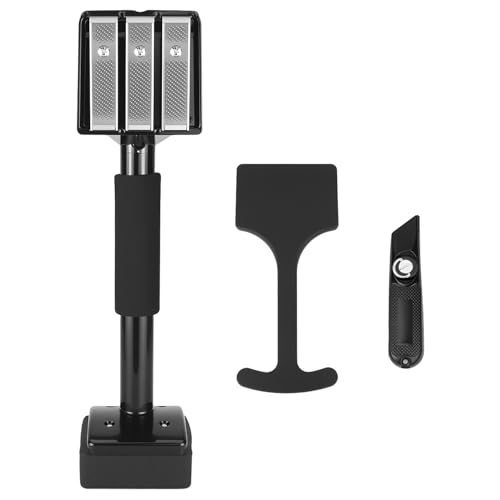
A knee kicker is a short, padded tool with a toothed head. You set the head against the carpet near the wall, push it forward with your knee, and the teeth grab the backing and push the carpet toward the tack strip. It is the standard way to take slack out of carpet in tight spaces such as closets and hallways, and to secure the last edge after a power stretcher has done the main pull. It is not a substitute for a power stretcher in large rooms, where uneven tension can lead to wrinkles and buckling later.
Features That Separate a Good Kicker
Adjustable Length
Length matters because the tool must reach comfortably between your knee and the carpet at your working height. A shorter fitter can usually work with 17 inches, while taller users may need 21 to 25 inches. Adjustable models, including the Roberts range and the Crain 505, let you change the reach. Fixed-length economy kickers are lighter but force you to adapt your posture.
Pin Depth and Teeth
Different backings and pile thicknesses need different tooth depth. The maker of the Roberts range stresses an easy-to-read dial for adjusting the steel pin depth, and one Crain reviewer lists nine pin-depth settings on the 505. Too shallow and the kicker slips; too deep and the pins can damage the backing or even the floor. Set the depth so teeth just grip the backing, then increase gradually.
Head Width
A wider head spreads the force and grips more area. Fitters who prefer the Crain 505 say it stretches farther with less effort, and UK sellers describe the Roberts GT 2000 as having a wider carpet head with more gripping area. A narrower head is easier to control in tight spots and around obstacles.
Knee Pad and Bumper
You will hit this pad repeatedly. A foam-filled seamless bumper, as on the Roberts Deluxe, cushions the knee, and a replaceable pad extends the life of the tool. Reviewers of cheaper kickers frequently complain about thin padding. Professionals commonly wear separate knee pads for comfort and safety regardless of the tool.
Body Material and Weight
Die-cast aluminum offers a balance of strength and weight. Lighter models of around 2.5 to 3 lb reduce fatigue over a short job, but heavier tools can feel more solid when stretching dense carpet. Professionals on forums report durability issues across brands, including a case of Roberts Deluxe units failing within months of daily use and two GT 2000 units breaking at the same point. That suggests even premium tools have a finite life under heavy work.
Pick X If: Decision Table
| If you are | Pick | Why |
|---|---|---|
| A homeowner doing one bedroom | QEP economy or Bon economy | Light, simple, low outlay |
| A DIYer planning several rooms | Roberts 10-410 or Pit Bull adjustable | Adjustable reach for different working positions |
| A working installer | Roberts Deluxe 10-412 or Crain 505 | Better build, adjustable pins and length |
| Stretching heavy or dense carpet | Crain 525 or Roberts GT 2000 | Wider head and heavy-duty frame |
| Fitting stairs | Crain 507 stair stretcher | A retailer names it as the best stairway option |
| Tall user | Longer range such as Crain 505 at 21 to 25 inches | Reach matches working height |
Using a Knee Kicker Correctly
Install tack strips first, leaving a small gap from the wall. Lay the carpet with a few inches of overlap, then use the kicker to push the carpet onto the strip at the starting corner. Work in a consistent direction, usually from one corner and across the wall, so that tension stays even. Strike with the knee pad, not the leg, and keep your knee protected.
Mind the safety points that makers and retail guides repeat: wear knee pads, keep fingers clear of the teeth, set pin depth appropriately, and avoid striking with a bare knee. Repetitive knee strikes carry a real risk of joint strain or bruising; if you feel persistent knee pain, stop and seek medical advice. Follow the manufacturer’s manual for adjustments and do not use a damaged tool.
Matching a Kicker to the Carpet
Backing type changes what works. Woven polypropylene backings and jute backings respond differently to tooth depth, and thick cushion-back or heavily textured carpets need more bite than thin commercial loop pile. Over a concrete slab, an overly deep pin setting can scratch or chip the surface, so a modest depth is wise. Always follow the carpet maker’s installation guidance, since some warranties specify stretching methods.
Trade-offs by Budget Tier
Budget
Economy fixed-length kickers from QEP and Bon cover occasional use. Reviewers note limited padding and tooth depth, so they suit small, simple jobs rather than new carpet over large areas.
Mid-Range
Adjustable models such as the Roberts 10-410 and Pit Bull telescoping kicker provide more flexibility. Expect compromises in weight or durability, but they handle several rooms for a homeowner.
Premium
The Roberts Deluxe 10-412, High Profile 10-422 and Crain 505 or 525 are the professional options. They cost more but offer replaceable parts, better pad construction and finer adjustment.
Alternatives
- Power stretcher: Essential for large rooms; a kicker is a complement, not a replacement.
- Stair stretcher: Models like the Crain 507 are made for stairs where a standard kicker is awkward.
- Rental tools: If you only need a stretcher once, renting a power stretcher and buying only an economy kicker can be sensible.
- Professional installation: For stretched wall-to-wall installs on large floors, hiring a fitter avoids buying tools you may not use again.
Frequently Asked Questions
What length knee kicker do I need?
Most adjustable kickers span about 17 to 25 inches. Shorter users tend to be comfortable around 17 to 21 inches, while taller users may want the longer range of a Crain 505. Try the tool at your working height before committing to a length.
Is the Roberts 10-412 worth it?
The maker calls it an industry standard for durability and comfort, and it is the most reviewed model in the sources consulted. Some installers report deformation or early failure under daily professional use, so expectations should match your workload.
Can I install carpet with only a knee kicker?
For small rooms and closets, yes. In larger rooms professionals use a power stretcher for the main tension. Relying on a kicker alone over long runs risks uneven tension and later wrinkles.
How do I set the pin depth?
Adjust the dial so the pins just penetrate the carpet backing without poking through to the pad or floor. Start shallow and increase until the head grips without slipping. Always follow the maker’s manual for your specific model.
Do I need knee pads with a kicker?
Yes, protective knee pads are widely recommended. The kicker’s bumper cushions each strike, but repeated impacts can still bruise or strain the knee. See a doctor if you develop lasting pain.
Are cheap kickers good enough for a DIY job?
For one or two small rooms, reviewers describe economy kickers as workable, albeit with thin padding and less tooth depth. For a whole house or new carpet, an adjustable model gives better control.




Write Your Review
No reviews yet. Be the first to share your experience!